

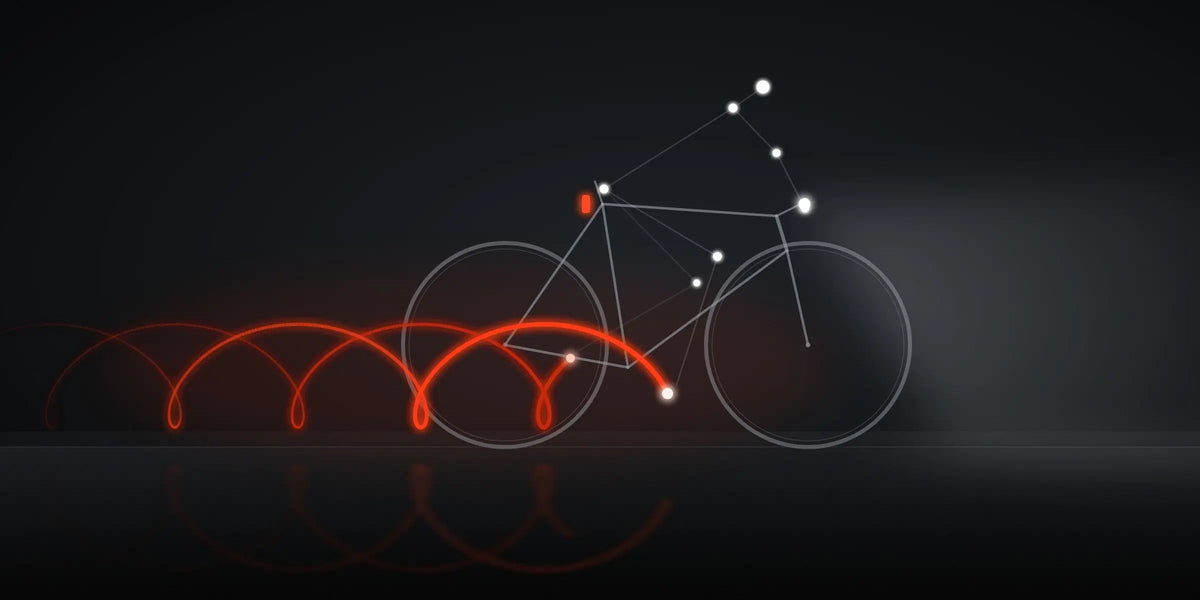
Run a front and a rear light on every ride from here on, day and night. Use the flash in daylight. And if you want drivers to recognize you as a person on a bike instead of a dot of light, give them something that moves.
On November 1 the clocks fall back an hour. Here in Vancouver, Washington, sunset goes from 5:58 p.m. on Halloween to 4:57 p.m. the next day. Same ride home, same route, and overnight a good chunk of it happens in the dark. That is the week to sort out your lights, not the week after you got caught without them.
The good news is that the research on being seen is more interesting than "buy the brightest light you can afford." Here is what it actually says.
Why run a light when the sun is out?
A driver looks right at you, then pulls out anyway. Clear afternoon, dry road, nothing in the way. They looked. They just did not register you.
That is the problem a daytime light is built to solve, and it has been tested properly. In 2004 and 2005, researchers in Odense, Denmark ran a controlled trial with 3,845 cyclists. About half got lights that flashed whenever the wheels turned, powered by magnets on the spokes, so they were on for every ride, day or night. The other half rode without them. Both groups self-reported their crashes online for 12 months.
The riders with the lights had 47 percent fewer injury crashes involving another road user.
The overall number, counting every kind of crash, came out smaller and less certain once the researchers corrected for how the two groups reported, so we are not going to oversell it. But the crashes a light is supposed to prevent are the ones with somebody else involved, and that is where the effect was clear.
Our take: once a light is on your bike, there is no good reason to switch it off when the sun comes up. Modern lights make it easy. The NiteRider Lumina Micro 950 runs its full 950 lumen flash for about 14 hours on a charge, according to NiteRider. On the back, the Vmax+ 180 Alto has an econ flash rated at 20 hours and a brake sensing mode that changes the light when you slow down or stop.
Lights on. Every ride.The flash is for daylight. That is when drivers least expect you.
Brighter is not what gets you recognized
Picture a dark road with a small red light up ahead. Is that a cyclist? A reflector on a mailbox? The taillight of a parked car? Your eyes found it right away. Your brain still has to work out what it is.
That second step is where riders get into trouble, and lumens do not solve it. Motion does.
A 2017 study at Clemson University tested it directly. Cyclists rode at night with either a full intensity taillight on the seat post, flashing or steady, or a half intensity light on each heel. The heel lights were tested with the rider pedaling and with the rider not pedaling. On a long, straight road, the heel lights on a pedaling rider were the most conspicuous setup in the test. Each heel light ran at half the seat post light's intensity, and the pair still beat it.
The same heel lights on a rider who was not pedaling came in last.
Same lights. Same rider. The only difference was whether the feet were moving.
What the night studies found
The most conspicuous setup on a long straight road. Each heel light ran at half the seat post light's intensity.
The same lights on a rider who stopped pedaling were the least conspicuous setup in the test.
Researchers at Queensland University of Technology report they made cyclists visible from six times farther at night than no reflective markings.
Cyclists overestimated how visible they were and underestimated how much ankle and knee reflectors helped.
Sources: Clemson University, 2017. Queensland University of Technology.
Researchers call this biological motion. A red dot could be anything. Two points going up and down in the rhythm of a pedal stroke read unmistakably as a person on a bike, and a driver's brain sorts that out fast. Reflective strips on your ankles and knees do the same job without a battery, as long as headlights reach them.
One limit worth knowing. In that same Clemson study, on a 90 degree curve where the bend limited how far ahead drivers could see, the seat post light did just as well as the pedaling heel lights. And the moment your feet stop, at a light or coasting, heel lights drop to last. So the answer is not to trade your taillight for ankle bands. Run both.
What we would actually do
- Run a front light in flash during the dayIt is a daytime running light, same idea as the ones on cars. Switch to steady when it gets dark enough that you need to see the road.
- Run a rear light every rideFlash in daylight. Brake sensing is a nice bonus, since it gives the driver behind you one more cue.
- Add something that movesReflective ankle bands, reflective shoe heels, or pedals with reflectors. Anything that traces your pedal stroke.
- Aim the front light down a littlePoint it at the road ahead of you, not into oncoming eyes. A driver who is squinting at your light is not seeing you any better.
- Charge on a schedulePick a night, plug them in, and stop finding out mid ride. A dead light protects nobody.
The light is how they find you. A flashing front and rear light makes a driver look your way, day or night.
The motion is how they know what you are. Something moving with your pedal stroke turns a dot of light into a person on a bike.
Bright gets you noticed. Moving gets you recognized.
Common questions
When does daylight saving time end in 2026?
Sunday, November 1, 2026. The clocks fall back one hour, and evening rides that finished in daylight the week before can end in the dark.
Should I run bike lights during the day?
Yes. In a 12 month controlled trial in Odense, Denmark, cyclists with flashing lights that ran on every ride had 47 percent fewer injury crashes involving another road user than cyclists without them.
Is a brighter bike light always better?
No. Brightness helps a driver notice you, but motion helps them recognize you. In a Clemson University study, half intensity lights on a pedaling cyclist's heels were more conspicuous on a straight road than a full intensity seat post light.
Do reflective ankle bands really help?
Researchers at Queensland University of Technology report that reflective strips on the ankles and knees made cyclists visible from six times farther than no reflective markings at night.
Need lights before the clocks change?
Tell us what you ride and when, and we will set you up with a front and rear pair that fits your bars, your seatpost, and your schedule. We have NiteRider, Garmin, and PDW lights in stock at the lab and ship nationwide.
Shop lightsThen charge them Sunday night.