

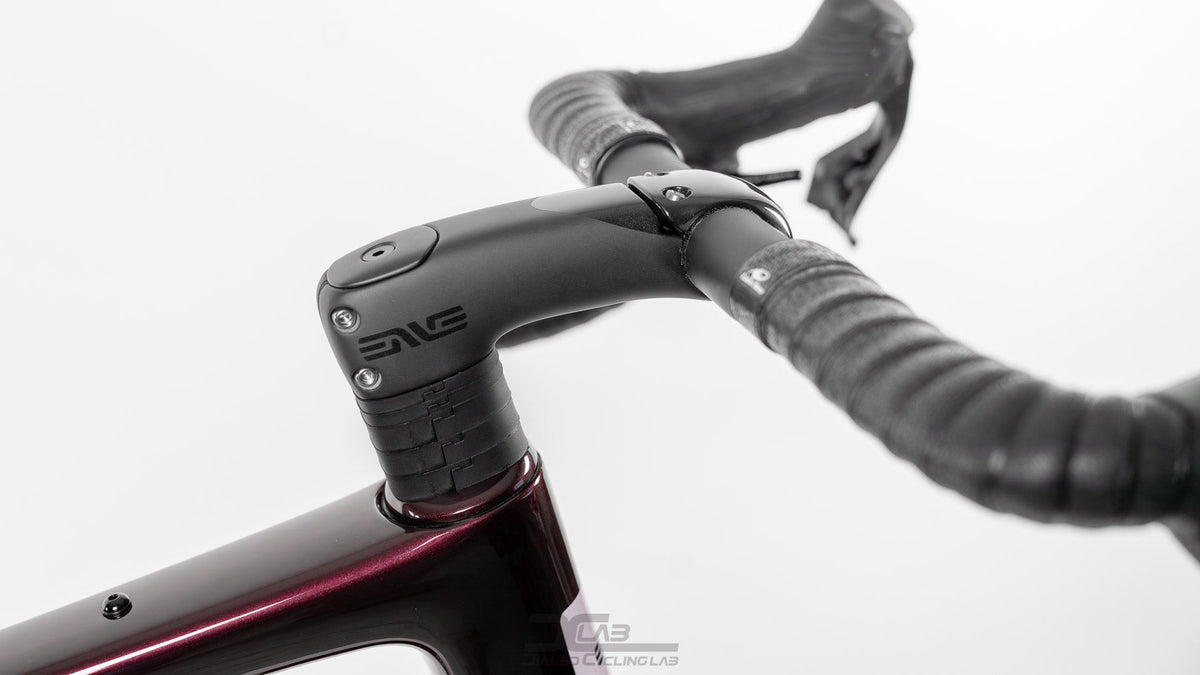
Pick your stem in this order: length first, angle second, material last. Length and angle decide where your hands land, and that decides whether a long ride ends with sore shoulders or with you forgetting the bars are even there. Once length and angle are right, carbon and one-piece cockpits are where the front end gets lighter, cleaner, and faster.
A one-piece carbon cockpit works best once you know your numbers. It locks length and width together, so the size you pick is the size you ride.
How long should your stem be?
If your hands go numb on the hoods, or your neck and lower back start complaining a couple hours in, stem length is one of the first things we look at.
Length moves your hands forward or back, and it changes how the bike steers. A shorter stem makes the steering quicker. A longer one slows it down and keeps the bike calm at speed. That is why trail bikes run short stems and road bikes run long ones.
The usual range on a road bike, where a longer stem keeps the steering calm at speed.
A little shorter than road, for quicker handling when the surface gets loose.
Short for fast, precise steering on the trail.
Jump 30mm at once and you are riding a different bike, with no way to know which part of the change helped.
When you compare stems, measure from the center of the steerer to the center of the bar.
One thing a size chart cannot tell you: frames in the same size can have very different reach. A longer-reach frame can need a shorter stem to put you in the same spot. Compare the frame's reach number before you compare stems.
A customer who was getting into gravel riding came in to see us with his Scott Addict Gravel and a couple of problems he could not solve on his own. About two hours into every ride his hands went numb and his neck started to ache, and he figured the frame was too big for him. We had him hop on the bike so we could see how he sat on it. The frame turned out to be the right size, so that was not the problem. The problem was how far the bike was stretching him out. His arms were locked straight and his shoulders were up near his ears, because when he set the bike up he had swapped in the 110mm stem from his road bike.
He switched to a 100mm stem and rode it for two weeks. He came back and said his hands and neck were better, but not fixed, so he went down another 10mm to a 90mm stem. That one solved both problems. He is still riding the same bike, and he likes to tell people he almost bought a new frame to fix a problem a stem solved.
Why does a -6 degree stem still point uphill?
Look at a road bike with the stem slammed and flipped down. The stem still angles up toward the bars.
That is because stem angle is measured against the steerer tube, not the ground. The steerer leans back at the head tube angle. On a bike with a 73 degree head tube angle, a stem sitting square to the steerer points 17 degrees above level. A standard -6 degree stem takes away 6 of those and still climbs about 11 degrees. You need a -17 degree stem before it sits flat.
So the number on the stem is not the angle you see, and angle is a bigger lever on bar height than most people expect. Flip the same stem from down to up and the bars typically come up 10 to 20mm, without touching a spacer. Spacers handle the rest: move one from above the stem to below it and the bars come up by that spacer's height.
That range of angles is why we carry the Zipp Service Course Stem in +/-6 and +/-25, and the Service Course SL in +/-6 and +/-17. On the dirt side, the Syncros XC 2.0 covers the shorter lengths.
Separate stem and bar, or a one-piece cockpit?
A separate stem and bar is still the most adjustable setup there is. Change the length, change the angle, try a different bar shape, and you are swapping one part. That is why we would rather you sort out your fit on a two-piece setup first.
Some systems split the difference. ENVE's IN-Route system offers both a separate stem, like the ENVE IN-Route Aero Road Stem, and one-piece bar/stem combos built around the same hidden routing. Go two-piece and you can still change length without replacing the bar.
A one-piece cockpit fuses the stem and bar into one carbon part. The upside is clean lines, fully hidden routing, and a shape that can be tuned for aero in ways a round bar cannot. Black Inc built its Integrated Aero Barstem AB02 to bring the Factor OSTRO VAM up to the level of the world's fastest bikes, with a 40mm deep aero profile across the tops that it tested in CFD and then in the wind tunnel.

On a one-piece cockpit like the Black Inc AB02 shown here, the bar and stem are a single molded carbon part, so each size is a fixed bar width and stem length. If you later want a stem 10mm longer, you replace the whole cockpit. With a separate stem and bar, you would only swap the stem.
The tradeoff is right there in the size chart. The AB02 comes in 28 combinations of width and length. The ENVE SES AR One-Piece comes in 20.
One-piece cockpits ask more of the bike, too. The AB02 supports internal routing for electronic and disc brake groupsets only. The SES AR One-Piece is built around ENVE's IN-Route system, with top bearing covers available to fit other brands. Check your frame and your groupset before you fall for the look.
Is a carbon bar or stem worth it over alloy?
Carbon is lighter than aluminum. But aluminum bars are not all the same, and a better grade of aluminum can save weight on its own.
TruVativ Atmos Carbon against the Atmos 7K in 7050 aluminum. Both are 760mm flat bars.
Zipp Service Course SL-70 XPLR in 7050 against the Service Course 70 XPLR in 6061. Same 70mm reach and 115mm drop, both at 42cm.
Comfort is harder to pin down, so here is what the brands say. TruVativ describes the Atmos carbon laminate as tuned to absorb noise while keeping its stiffness. ENVE says its G Series bar uses a layup with more compliance than its other bars, and those other bars are carbon too. So comfort comes from how a specific bar is designed, not from the material alone. Some carbon bars are built to be stiff, and others are built to flex a little.
Our take: choose a carbon bar for what that specific bar does. The weight, the shape, and how it rides are what you are paying for.
Carbon asks for more care at install. SRAM's manual for its TruVativ bars and stems, alloy and carbon alike, calls for friction paste on the stem, no lubricant on the contact surfaces, and faceplate bolts tightened evenly so the gap matches top and bottom. It also says to inspect bars and stems regularly for cracks, dents, deformation, discoloration, scratches, or creaking, and to replace anything damaged. Use a torque wrench like the Feedback Sports Range Click and a carbon paste like Silca Hold Fast.
The stem matters for a carbon bar too. ENVE machined beveled edges into the clamp on its alloy mountain stems for more even clamping and less risk of damaging a carbon bar.
Common questions
How do I measure stem length?
Measure from the center of the steerer tube to the center of the handlebar clamp. Most stems also have the length printed near the bolts.
What does a -6 degree stem mean?
The stem sits 6 degrees below square to the steerer tube. Because the steerer leans back, a -6 degree stem on a bike with a 73 degree head tube angle still points about 11 degrees above level. A -17 degree stem sits level on that bike.
Is a one-piece cockpit worth it?
It is worth it once your fit is settled and your bike's routing supports it. Every size is a fixed width and length, so changing reach later means replacing the whole cockpit.
Is a carbon handlebar more comfortable than aluminum?
Not automatically. Brands tune carbon layups to be stiffer or more compliant, so comfort depends on the specific bar. Carbon usually saves weight: the TruVativ Atmos Carbon flat bar is 190g against 250g for the alloy Atmos 7K at the same 760mm width.
Before you buy anything

Measure your current stem and write down the length and the angle printed on it. Those two numbers are where every option above starts.
Every bike we sell gets a quick fit before it goes home, so you start out comfortable and in the right position. If you are changing the stem on a bike you already own, we are happy to answer your questions and help you narrow down a length, and installing it is billed bench work.
Shop Stems