



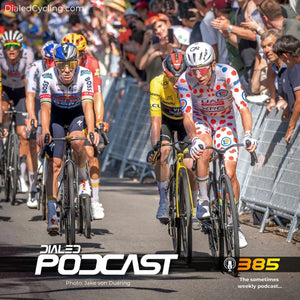
The Rundown: Four months is a long time between podcasts, and the guys came back with plenty to say. Ian and Lance just got home from a week climbing the French Alps, Lance is 36 races deep since the last time the mics were on, Jake watched the Tour de France roll through Barcelona from the side of the road, and an American just won the world championship road race. It is also the first podcast recorded in the brand new Dialed Cycling Lab. Read on for the highlights, then hit play above for the full conversation.
Dialed Podcast 385 recap
The open is a little rusty, and the guys own it. Jake admits he barely remembers how to start the show, the intros take a couple of tries, and Lance sums it up best: they are so out of practice they no longer know what they are saying. It does not take long to find the rhythm again.
The Backpedal: a half marathon, a lot of crits, and a 25-pound difference
Matt kicks things off with a running story. His Achilles is finally behaving, he is down about 10 pounds, and his wife talked him into the Portland half marathon with almost no notice. She dropped him for the first five miles, then stopped for a bathroom break, which Matt calls a secret of the greats: wait for the porta potties, then attack. A stranger on the course suggested they try to break 1:40, Matt closed strong, and he came in right around 1:39. The finish was a mess, with the half marathoners funneled into a crowd of slower 10K runners, so he spent the last stretch apologizing and asking strangers if he was even going the right way. Lance fills in the backstory on how the Portland Marathon changed hands after its longtime organizer was sentenced for embezzling from the nonprofit behind it. Matt's takeaway on racing again? Not yet. He is happy just running every day.
Ian has been riding in the sunshine, lifting through the start of his off season, and racing more than he lets on. He placed well in the 60 plus field at the A and B tune up crit on Swan Island, then had a rough day at the Oregon Championships crit by the Lloyd Center when a crash opened a gap in front of him and he burned too many matches trying to close it. That led to a good point about masters racing: when fields lump several age groups together, you often have no idea who you are actually racing. Jake floated color coded numbers by age group, the way Monday Night PIR has done it by category. Ian also crushed the two bonus PIR races in August, finishing eighth overall in an 81-rider field and sprinting alongside riders in their twenties. Not horsepower, he says, just race craft.
Lance pulled up his calendar and counted 36 races since the last podcast, including 14 cyclocross races already this fall, with more on the way. He has a video for nearly every one of them on his YouTube channel, including a couple of barrier bunny hops that make Matt nervous. He also rode the Oregon Trail Gravel Grinder, got pummeled the first couple of days, and came around to have a great time. His other big project this fall: he has gone from over 190 pounds at the Portland crits in August to 165, and he made a change to get there. After years as a vegan, he started eating fish to get enough protein, cut the Haribo, and watched every macro. Ian added the part people miss: cut calories without enough protein and lifting, and a big share of what you lose can be muscle, which is exactly what you do not want on a bike.
The new lab and the Dialed Garage
With Matt stepping out for a phone call, Lance and Jake gave a tour of where the podcast now lives. The lab moved about 12 inches west and grew from roughly 1,500 square feet to 3,600, with a much bigger service area, a private office, and a dedicated studio for the podcast and video.
The old space has a new name: the Dialed Garage. Part of it holds inventory for online orders. The rest is home to pre-owned bikes, the consignment program Jake started years ago when a customer asked for help selling a bike, lightly used takeoff parts, and open box gear from the lab. It is also where the team's donated gear lands. Junior riders get first pick of bikes, clothing, shoes, and helmets they need. Whatever they cannot use goes on display for the community at a fraction of what it would normally cost, and the net proceeds go back into Bikes for Kids, the juniors program, and the team's other community work. Cycling is expensive, and this is one way to help with that.
There are some fun bikes on the floor too, including a Factor ONE SpongeBob Edition the lab just finished building. Lance also points out why Jake has been hard to find this year: on top of the move, he rebuilt the website, and the lab is now shipping orders out every single day.
Champ Bailey: an American world champion
Champ Bailey, Lance's racing news alter ego, made it to the new studio, and the big story is the world championships in Montreal. Brandon McNulty won the men's road race on September 27, the first American man to take the rainbow jersey since 1993. Lance's read on how the US team did it: Quinn Simmons, McNulty, and Matteo Jorgenson agreed it did not matter which of them won, as long as one of them did. Simmons went up the road early, which let the other two sit in. Once that move came back, McNulty attacked, and Jorgenson was there to cover the counters. McNulty held on to win by 13 seconds.
The guys think Simmons is due for a big one too. He came close at Il Lombardia last year, spending almost 50 kilometers alone off the front before Tadej Pogačar caught him on the way to fourth. With Pogačar out after his crash at the Vuelta, the field looks wide open. Ian thinks racing is more exciting without him in it. Jake sees it the other way: watching Pogačar is like watching Michael Jordan in his prime, and you do not always realize how special it is while it is happening.
Jake at the Tour de France
Jake closed out a two and a half week family trip through Italy, Switzerland, France, and Spain in Barcelona on purpose, because that is where the Tour de France started this year. He skipped the opening stage and went for stage 2, which finished with a circuit on Montjuïc. Instead of one blink-and-you-miss-it pass, he got to see the whole race go by three times, moving down the climb between laps to get new angles. Isaac del Toro won the stage. The next day a missed bus and some bad information changed the plan, so he went to the start and watched the whole peloton roll out together before the racing began.
Between the two days he shot more than 3,000 photos on a 70-200mm lens, including clean shots of Mathieu van der Poel, Quinn Simmons, and a sequence of Pogačar glancing back to mark Jonas Vingegaard while Remco Evenepoel rides behind them. The podcast cover is one of his. His advice for anyone thinking about it: go watch a stage or two in person, plan around the route, and take it all in. Barcelona's transit made it easy, the parade of motorcycles and team cars before the riders goes on longer than you would believe, and walking past the team buses after the finish is worth the trip by itself.
EPO Chain Mail: racing the day after a big trip
The first listener text came from Missouri. They were flying home from a week of riding in Europe with about 30,000 feet of climbing and had a race less than 24 hours after landing. Any advice? And are they psycho?
Matt says confirmed psycho. Lance says perfectly sane, because he did the exact same thing. After about 25 hours and roughly 35,000 feet of climbing in France, he landed, drove out to Cascade Locks the next morning, and made the podium in a cyclocross race. The next day he took second in the same field. He did five races in seven days after getting home and, for once, did not get sick from the trip.
Matt pointed to supercompensation, the idea that a big block of volume followed by a quick drop can leave you riding better than expected, the same reason training camps often end with the best day of the week. Jake backed it up with his own story: the day after riding Seattle to Portland as a race, about 206 miles in nine and a half hours, he went out for a 40-mile recovery ride and felt amazing. It was the day after that when it caught up with him. Ian added that if you keep riding day after day, you will break down eventually, but you can wake up feeling better than you went to bed more often than you would think. Matt and Lance both pointed out that cycling is easier to back up than running, because there is no pounding.
EPO Chain Mail: explaining a high-end bike to everyone else
The second text asked how you explain to every non-cyclist you meet why an expensive bike is actually a good deal, and suggested a feature that has your Garmin loudly announce your FTP to everyone in earshot when you stop for coffee. Matt figures it could be a Connect IQ app. Ian says his Wahoo already has a bell you ring by tapping the screen, so it is not much of a stretch.
On the real question, Jake goes back to something he says often: people put their pension where their passion is. Once you fall in love with something, you start to see why the details matter, and if a nice bike gets you excited to ride and you can afford it, go for it. If you are choosing between that and food on the table, don't. Ian pointed out that cars and motorcycles cost far more at the high end, while the best bike in the world is still within reach for a lot of riders. Matt's version is simpler: his father-in-law gives him grief about his bikes every visit, and his other son-in-law collects cars.
Riding the French Alps: what it takes and what it costs
This is the heart of the podcast, and it is worth listening to in full if a trip like this is anywhere on your list.
Ian and Lance spent a week based in Bourg-d'Oisans, the small town at the bottom of Alpe d'Huez with, by Lance's count, eight restaurants and five bike shops. Cycling is everywhere there: the infrastructure, the art, the posters, the local economy. Over the week they rode Alpe d'Huez, the Télégraphe and Galibier, the Col de Sarenne, and the Croix de Fer, plus a handful of balcony roads cut into the cliffs that are too narrow and too broken up to ever host a race. Those turned out to be some of the best riding of the trip, including tunnels so dark you could not see. A few of Lance's Strava followers chimed in the moment he posted from the valley with rides they should not miss.
The big lesson was respect. Ian rode Alpe d'Huez on day one, not pushing it, at close to threshold, and it took him an hour and fifteen minutes. The Télégraphe and Galibier together took the two of them three hours of constant climbing at 9 to 10 percent, topping out on the Galibier at about 8,700 feet. A few months earlier, stage 20 of the Tour de France packed the Croix de Fer, the Télégraphe, the Galibier, and the Sarenne into one day before finishing on Alpe d'Huez, and Richard Carapaz won it. Riding those roads yourself is the fastest way to understand how superhuman the pros are. Funny enough, the guys rated Alpe d'Huez the least interesting climb of the week, and they were still pinching themselves the whole way up.
Jake asked the practical questions, and the answers are encouraging. The trip came together in a couple of weeks. They flew into Geneva for about $1,800 round trip, rented a car so they could stay a night in another village and keep the Galibier day reasonable, booked a small Airbnb for about $1,000 for the week, and rented decent bikes in town for about $350 for the week. Total travel time was about 16 hours door to door.
A few things they learned the hard way. The Airbnb did not include sheets or towels, so their first errand was a trip to the store. In shoulder season, many restaurants do not open for dinner until 8 p.m., which is after both of them are in bed, and a couple of places turned them away even with open seats. Geneva is expensive, but prices drop as soon as you cross into France. On the upside, September and October are the best time to go, with cooler temperatures and fewer thunderstorms, and they did not see a drop of rain in eight days.
Who is this trip for? An experienced rider in good shape. The guys suggest being comfortable riding 8 to 10 hours a week, and Lance puts it as a Strava fitness score in the 70s or higher. There is a short flat bike path in the valley, but on most days you are climbing the moment you leave the door. You can go solo or with a tour, but having a riding partner at a similar level made it better. For planning, they found a site listing rides by valley with starting points and built their own routes from there. Ian's verdict: just go do it.
One last thing
Matt has a deep dive coming on the new heart rate sensor in the latest Apple Watch. Apple published a study claiming the best heart rate accuracy, and Matt questioned how it was run: no listed authors, no public data, and comparisons to other watches rather than to a chest strap like the Wahoo TRACKR, which should be the control. He got on a call with the team behind the study and came away more impressed than he expected, since it includes thousands of participants. The video is not out yet, so subscribe to his YouTube channel to catch it when it goes live.
Ian admits his motivation is fading now that the season is winding down, even with great October weather. Jake's prescription: go ride your gravel bike and do whatever sounds fun. Lance has put out about 35 videos since the last podcast, is closing in on 1,900 YouTube subscribers, and still has several cyclocross races left, including the Cyclocross Crusade Coyote Run. He also just found out Ian has signed them both up for a camp in San Luis Obispo the first week of December.
Jake closes it out happy to be back behind the microphone. There is a new podcast page at dialedpodcast.com with recaps and every podcast, the shows are on YouTube now, and the plan is to be back next week. If you are in the area, stop by the new lab and say hi.
Talk to the guys
Got a question or an idea for the show?
Ask us anything about the podcast, pitch a topic for a future episode, send general feedback, or ask about gear. We read every one.