



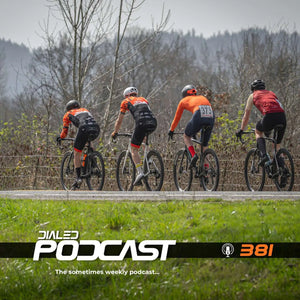
The Rundown: The guys are back around the table, and Episode 381 settles into the conversation every local racer has had at one point or another: what does it actually take to keep amateur bike racing alive, and when do you finally move up a category? Along the way Lance recaps a spur-of-the-moment 1,400-mile drive to a fondo in Arizona that ended in an emergency root canal, Ian walks through how his Michael Myers team time trial went, and the table geeks out over Mathieu van der Poel holding 446 watts for 90 minutes. Jake, Lance, Ian, and Matt are all in. Pour a coffee, settle in, and hit play above. Here is what went down.
Dialed Podcast 381 Recap
A Disheveled Open
The episode opens with all four of them looking a little worse for wear and owning it. Lance invents a word to describe how his head feels, Matt cheerfully points out that everyone has looked better, and the table riffs on the idea of a smell-o-vision podcast before anyone gets down to business. If you are new here, this loose, punchy open is the show at its most natural. If you have been around a while, you know exactly the feel.
The Backpedal: Track Meets, E-Bikes, and a Week From Hell
Every episode kicks off with the Backpedal, where the guys recap what they have been up to since the last show.
Matt has been buried in track season. He spent eight hours running the finish-line timing at a meet that moved up to the bigger stadium this year, which means more spectator room and a much better setup on a rainy day, but a far bigger haul of equipment to move every single time. On the bike, he has been mixing in swims, runs, and a fair bit of e-biking, including a mellow cruise with his wife on a lightweight e-bike he is reviewing. His honest take: it is not really a workout, it is a great break, and it beats no riding at all.
Ian got out for a beautiful 71-mile tickle creek loop with a mellow group, kept up his two-to-three-days-a-week gym habit, and has happily switched back to structured intervals now that the weather has him indoors. There is something refreshing, he admits, about feeling like you are training again after a long winter of base miles. Getting a race under his belt a couple weeks earlier lit the fire.
Then Lance told the story of his week. His buddy Gary called at 4pm on a Tuesday to invite him to El Tour de Scottsdale, and Lance was in his van by six, driving the better part of 20 hours each way with stops at the Grand Canyon, Bryce, and a few ghost towns along the way. The race itself, a 62-mile fondo with 3,000 feet of climbing and around 3,000 riders, went great. He averaged 23 miles an hour, got to ride alongside former pro Bobby Julich, and felt strong. The catch came right after: a crowned tooth's nerve died, he needed an emergency root canal, and he spent five days in serious pain while also caring for his wife after her shoulder surgery. He still called it a great week, which tells you everything about Lance.
The Leadout: Classics Season and a Power Number That Breaks Your Brain
It was the heart of Classics season when the guys recorded, and they ran through a stretch of races that delivered. Van der Poel won a wild Milan-San Remo that cost Lance a bet and earned Matt a shamrock tattoo, Tom Pidcock crashed off a descent after a mistimed bottle grab, and Remco Evenepoel had one of those freak tip-overs that happen the instant both hands leave the bars.
The number that stopped everyone cold came from van der Poel's ride at Dwars door Vlaanderen, where he attacked solo and held a normalized 446 watts for the final 90 minutes of a five-hour race. To put that in perspective, the guys pulled up their own best efforts right there on Strava: Lance sits around 272 watts for an hour, Jake around 342, and even Jake's 15-minute best of 422 falls short of what van der Poel sustained for an hour and a half. If you have a power meter, Jake's tip is to open your own best-efforts list and work backward until you find a duration where you brush 446 watts. It is humbling, and it is the whole point.
That rolled into a great thought experiment: is Tadej Pogacar already the greatest of all time? Lance and Ian argued the comparisons across eras are almost meaningless given how much diet, training, and equipment have leveled and widened the playing field, and yet Pogacar still rises well above it. Whether he chases Eddy Merckx's records or simply gets bored and walks away early, the table agreed the sport is more fun when a young challenger like Paul Seixas or Isaac del Toro is climbing toward him.
EPO Chain Mail: A 65-Day-Late Thank You and a Great Category Question
The EPO Chain Mail segment is where the guys read listener mail, and three good ones came in. First, a listener wrote back to say the New York travel advice from a previous episode reached him exactly as he drove from the airport to his hotel, 65 days later. The guys took full credit for the impeccable timing.
The best of the bunch came from Portland: for local road racing, when should you move up to Cat 3, and is it safer? The whole table agreed on the safety answer without hesitation. Yes, it is meaningfully safer, because Cat 3 fields are full of riders who know how to hold a line and ride inches from your wheel, the exact skill that is missing in the lower categories and at no-category fondos. The bigger jump, Ian noted, is really from Cat 4/5 up to 3, since by Cat 3 you are already among experienced riders.
On the when, the guys landed on a simple answer: go when you are ready, and do not let nerves hold you back. Move up if you are consistently faster than your field, for your fellow racers' sake, or once you have the experience to ride safely in a tighter, faster pack. They also dug into how hard it actually is to earn the points locally, since the area no longer has enough road races to rack them up easily. Ian's plug, naturally, was that the right time to move up is right after you sign up for a coaching program so you arrive prepared.
The Big Topic: What It Takes to Keep Local Racing Alive
The main topic brought the conversation down from the pros to the local scene, and it is the most honest stretch of the episode. The state of amateur bike racing, the guys agreed, is healthy but smaller than it was, with gravel having taken over a big slice of what used to be a packed road calendar. Gravel works as a business because promoters can charge 150 dollars and riders will happily drive hours for it. A grassroots road race, by contrast, lives or dies on volunteers and can barely charge 50 dollars before people balk, which is exactly why so few of them still happen.
That led to the real point: the racing only exists because people choose to keep it going. Almost none of the local road races are run by promoters; they are run by teams, which is why Ian is putting on the Barton Park Road Race himself. The guys made the case that if you are going to race, you should also contribute, and that splitting the work of permits, registration, promotion, and driving across a few people makes putting on an event far less daunting than it sounds. Ian even pointed out it can turn a small profit. Jake added a practical angle for any rider sitting on the fence: small towns like Camas have lodging-tax grant money set aside to attract events, so the funding to start something new may already be out there.
Then the talk turned inward to the health of their own team, and Jake did not dodge it. With a roughly 150-person roster, only a fraction race regularly, and Ian was candid that an empty start line takes the wind out of the racers who do show up. The four of them worked through the why with a lot of grace: life happens. People join, life gets busy with jobs, kids, moves, and health, and they fade out, often returning years later with no hard feelings. Jake's framing was the standout. He compared the big commitments in life to ping-pong balls and everything else to sand, and pointed out that if you pour the sand in first, the ping-pong balls never fit. Between roughly 70-hour work weeks, college tours with one kid, cross-country trips to another, three separate health issues, and the new lab space nearing move-in, his own jar has been full. He owned the lull in team leadership plainly, and he was just as clear that the team is about to ascend again, with the 10-year anniversary coming up next year.
The takeaway the guys kept circling was a carrot, not a stick: reward the people who show up and represent the team, encourage the fence-sitters with a personal invite instead of a guilt trip, and treat the warm leads already wearing the kit as the easiest people to bring out to a race.
One Last Thing
Each host closes with a final note. Matt plugged a new sponsored review of a lightweight e-bike and teased that he is getting back to the watch reviews soon. Ian made his pitch for the Barton Park Road Race on May 9th, a 50-dollar grassroots road race near Estacada with a punchy two-minute climb called the Eden Wall near the finish, and put out the call for nine volunteer drivers. Lance lined up a stack of weekend racing, from the Madras mountain bike race to the Sasquatch Duro gravel race and Banana Belt. And Jake teed up a busy weekend at the lab.
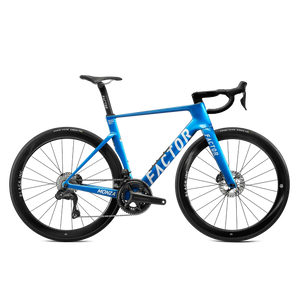
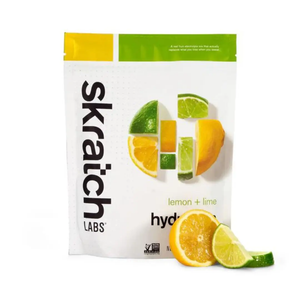
There was also a piece of team news worth flagging. The new team kit store is moving to a new vendor that keeps the store open year-round, owns its own factory, ships direct to each rider in about three weeks, and uses a photo-based AI sizing tool with a fit guarantee. Jake also confirmed upcoming team group buys in the works with Factor, Kask, Lake, Skratch Labs, and Silca.
Listen to the Full Episode
This recap only scratches the surface. The full episode is packed with the kind of unfiltered banter, race breakdowns, and hard-earned wisdom that only comes from four guys who genuinely love this sport. Hit play on the player above, or find Episode 381 of the Dialed Podcast wherever you get your podcasts.
And if the talk about moving up a category or getting race-ready has you thinking about your own setup, we stock the gear that backs it up at the lab, from a proper race helmet to dialed-in shoes and race-day nutrition. Even better, come say hi and we will help you sort it out. We are always happy to help you get dialed.
More Gear From This Podcast
Talk to the guys
Got a question or an idea for the show?
Ask us anything about the podcast, pitch a topic for a future episode, send general feedback, or ask about gear. We read every one.