



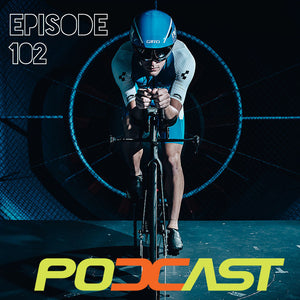
The Rundown: Podcast 102 is a full shop-talk session on how air resistance shapes the way we ride. Before that, Lance checks in from the road in Utah, the guys swap trainer, running and gravel stories, and they dig into the cyclocross World Championships and some pro peloton chatter. Then the guys break down yaw angle, drag and frontal area, and what helps most: body position, tight clothing, a good helmet, wheels, frame and tire choices. They also talk about a new Garmin aero sensor. Read on for the highlights, then hit play above for the full conversation.
Dialed Podcast 102 recap
The Backpedal: trainers, base miles and warm-weather escapes
Lance joined from the road in Southern Utah, heading toward Arizona for warmer miles after a Super Bowl weekend with college friends. He did a trainer workout in a freezing garage with his buddies watching, got through a hard four by twenty minute session, and was building base with a big week on the bike. He also came back from a first-ever leg wax, done by a friend's wife with no experience, and the guys swapped their own waxing horror stories.
Evan had a trainer-heavy week and another Zwift race, then helped a friend move to Bellingham before getting back for the Lakeside long run, where he pulled into the parking lot right at ten o'clock. Matt was thrilled to run ten miles again and feel good. Jake did juniors rides and a nearly three-hour gravel ride on his own, holding steady watts.
Leadout News: cyclocross Worlds
The guys went through the cyclocross World Championships. The women's elite race ended with a sharp sprint after a steep descent into a left-hander, and Katie Compton had a strong ride behind the Dutch trio. They also noted that American women are building real depth in the sport, and that a young American took a podium spot in the new junior women's race.
On the men's side, Mathieu van der Poel dominated, which nobody was surprised by. The guys called out the young British rider in second and Wout van Aert's impressive fourth after his time trial crash. They also wondered what it would look like if the UK put its organizational weight behind cyclocross the way it did for track, and noted that the sport is a great one to watch.
Bikes, brands and the peloton
The conversation drifted to Canyon and Pinarello, and why top pros and triathletes end up on certain bikes. The guys came back to a point they agree on: bike brands and money matter, but a pro won't ride a bike that holds them back. They also touched on the ketone supplement discussion around one pro team and on new talk linking a controversial coach to current pro activity, agreeing that the doping topic deserves its own podcast.
Aerodynamics: why it matters and how drag works
The main topic started with a simple idea: speed on a bike depends on watts and air. Around seventy to eighty percent of the drag comes from the rider, not the bike. Matt explained yaw angle, the angle the wind hits you at, and why most real-world riding sits at small angles, so designs optimized for extreme ones don't help much. He also explained why teardrop shapes beat round tubes by smoothing out the turbulent low-pressure wake behind an object.
The guys also pointed out that slower riders shouldn't ignore aero. They spend more time on the road, so a given saving still adds up to about the same share of their ride. The same logic helps explain why drafting is such a big deal on group rides.
Where the biggest gains come from
Jake read numbers over a flat forty kilometer time trial: roughly two minutes from an aero road frame versus a traditional one, two minutes from a skin suit, about a minute from an aero helmet, and under a minute from deeper wheels. The takeaway the guys kept returning to was that tight clothing is far cheaper than a new bike. Loose, flapping fabric costs real time, and dimpled fabric on arms and shoulders works a bit like a golf ball.
They also covered the front end: aero bars, cables, gloves and the area of the hands. Disc versus rim brakes was a lively debate, since discs let designers shape forks and frames differently but the aero data isn't clear yet. Shaving legs and arms was mentioned as another cheap gain, though beards didn't show a clear effect.
Tires, rolling resistance and the myth of wide equals aero
On tires, Matt pushed back on the idea that wider tires are more aerodynamic. Narrow is technically more aero, but wider tires can still be faster because of lower rolling resistance and rim-and-tire shape working together. Road surface, pressure, rim width and fork design all affect the answer, so there's no single best width.
The guys' advice was to know the course and conditions, pick a setup for that day, and keep an all-around option for training. Jake also noted that his wide gravel tires felt surprisingly quick on pavement.
Body position, flexibility and a new Garmin sensor
The most surprising section was on position. Jake went through wind-tunnel-style numbers showing hands on the hoods with arms parallel to the ground needed far fewer watts than hands in the drops with straight arms, with a gap of about sixty watts between the fastest and slowest. Evan added that the goal isn't just getting flat, it's creating a smooth hill from helmet to back, and that hip angle and spine flexibility determine how much power you keep.
Matt closed the topic with a look at a coming Garmin aero sensor, which uses wind speed and pressure to estimate CdA live, and could even estimate power if you don't own a meter. In One Last Thing, Evan stressed that most drag is you, so changing your own position costs nothing, and Matt talked up his YouTube goggle reviews.
Listen to the full podcast
This recap only scratches the surface. Hit play on the player above, or find Dialed Podcast 102 wherever you get your podcasts.
More Gear From This Podcast
Talk to the guys
Got a question or an idea for the show?
Ask us anything about the podcast, pitch a topic for a future episode, send general feedback, or ask about gear. We read every one.