



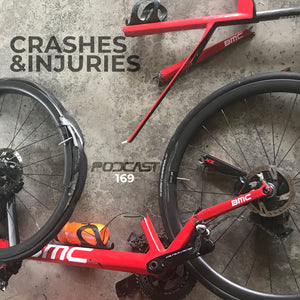
The Rundown: Anyone who rides or races long enough will crash eventually, so this week the guys talked through what to do when it happens. Jake von Duering and Lance Heppler cover the split-second reactions, how to check yourself and a friend for head injuries, and why you should not get back on the bike too fast. They share their own crash and injury stories, what recovery looked like, how a crash can stay with you mentally, and how to ride predictably in a group. Read on for the highlights, then hit play above for the full conversation.
Dialed Podcast 169 recap
The Backpedal: a quiet week for Lance
The Backpedal opens with Lance sitting out a planned race after his neurosurgeon told him his back was not healing and needed a couple of weeks of rest. He cut out intensity and rode roughly a hundred miles instead of his usual two hundred and fifty, with the goal of being ready for a big race in two weeks. The guys joked about doctors who do not ride bikes telling cyclists to take a break.
Jake had a solid week of nearly eleven hours on the bike, including a big flogging ride where a bit of wheel touching led to some bruised egos and road rash, but nothing serious. He also rode with Lance on Saturday, and the two came away admiring a beautiful stretch of road north of Felida.
What to do in the first seconds of a crash
Lance's first rule is to avoid putting your hand or arm out to catch yourself, since that is how collarbones and wrists get broken. He tries to tuck and roll onto his shoulder instead, which beats breaking a wrist even if it costs some skin. Wear a helmet, and know that sometimes it just happens too fast to think.
Once you are down, the biggest concern is head, neck or spinal injury. If your head or neck took a hit, do not move. Let someone else move you or wait for EMS. The guys pointed to a rider at the Giro who snapped his bike in half on a descent, stood up and tried to carry on, then started looking dizzy by the guardrail.
Jake's trail crash and the long ride out
Jake told the story of the mountain bike crash that broke his femoral neck. A deer spooked him on a single-track trail, his wheels washed out, and he landed hard on his right hip. He knew right away something was wrong but managed to get back on the bike, only to find he could not pedal once he reached the bottom of the trail.
He started to feel faint while on the phone with his wife, and then a few other riders came by and stopped to help. They pushed him up the hills, and he coasted out using the bike like a wheelchair. He ended up with three titanium screws in his hip. His takeaway: think twice about where and when you ride alone, and let people know where you are.
Checking for a head injury
Lance and Jake both stressed that people often feel fine after hitting their head when they are not. Amnesia is common, and some riders lose track of an hour or two without realizing it. Signs the guys listed include repeated questions, memory gaps, odd speech, eyes that do not track well and uneven pupils, plus a damaged helmet as a clue that the head took a hit.
Both have been through it. Lance remembers a doctor teammate looking him in the eye after a high-speed crash and asking what day it was and who the president was. Jake could not answer any of those questions after a snowboarding crash and was sent to the hospital. Both also described how a stranger at the scene, like a nurse or a firefighter, can make a huge difference. Some basic first aid and head-injury training is worth having if you ride and race.
Recovery: listen to your body, and your doctor
Jake told the story of a mountain bike crash that tore up his shoulder and led to months of physical therapy, partly because he waited too long to get it looked at. His advice: if something hurts for more than a couple of days, go see the doctor. Lance admitted that pushing through pain is a habit for endurance athletes, and that it does not always serve you well when you need to rehab.
The guys agreed that having a plan with a medical professional helps, and that putting a goal on the calendar gives you something to work toward. Jake followed his doctor's rules closely after his hip surgery, kept his butt on the saddle, never skipped physical therapy, and signed up for a big mountain bike race six months out.
Fear after a crash, and riding safer
Jake opened up about dealing with PTSD since being hit by a car. Some days he chooses the trainer over riding alone outside, and group rides help. Lance noted that while you cannot control cars, you can control where you position yourself and how closely you watch for trouble, like taking the lane when a car passes with its blinker on.
On group rides, the guys said to be predictable, avoid half-wheeling, and notice riders who are strong but unsteady. If you have experience, teach newer riders kindly instead of yelling. Lance also pointed out how much luck is involved, and Jake reminded listeners to make good decisions and ride with others when they can.
Leadout News: Giro, World Cup and local racing
In Leadout News, the Giro was in full swing, including a mountaintop finish with a gravel section where Egan Bernal took the stage and the pink jersey. Caleb Ewan picked up a couple of sprint wins before leaving the race, and Peter Sagan won a stage in a sprint. At the mountain bike World Cup in the Czech Republic, Haley Batten won the short track and took second in the cross country, and Tom Pidcock won the men's race by a big margin.
Closer to home, Paige Edwards took a podium at a UCI race in Wisconsin, and the guys were thrilled for her. They also checked in on teammates who raced Vance Creek and wrapped with a welcome for a new hand at the Lab.
Listen to the full podcast
This recap only scratches the surface. Hit play on the player above, or find Dialed Podcast 169 wherever you get your podcasts.
More Gear From This Podcast
Talk to the guys
Got a question or an idea for the show?
Ask us anything about the podcast, pitch a topic for a future episode, send general feedback, or ask about gear. We read every one.