



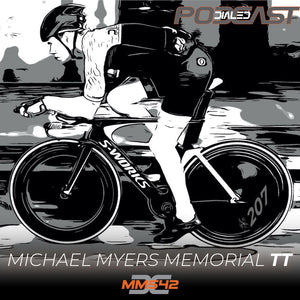
The Rundown: Jake von Duering, Lance Heppler and Matt LeGrand spend most of this podcast talking through what it takes to turn a good time trial into a great one, with the team's own Michael Myers Memorial Time Trial as the working example. Evan Price joins for the first stretch. The guys cover how to bring triathletes and roadies together, how to grow the Eddy road bike category, how many age and junior classes make sense, how deep a rim should be allowed, and how to give the finish line a real party feel. They wrap with their weeks of riding. Read on for the highlights, then hit play above for the full conversation.
Dialed Podcast 207 recap
Bringing roadies and triathletes to the same start line
Early in the podcast the guys settle on what they are talking about: the team's upcoming Michael Myers Memorial Time Trial, and how to make it a time trial people want to come back to. Evan, who coaches a number of triathletes, is pretty sure the early-season timing works in the event's favor, since most triathletes aren't yet deep into race builds and many are just getting their time trial bikes off the trainer for the first time in a while.
The idea that gets the most laughs is a friendly contest between the roadies and the triathletes, with a point system to be sorted out on a future show. That leads into UCI bike legality, the fun of seeing who is actually fastest locally, and a few stories about recumbents and human-powered vehicles that would flatten everyone on the course.
Chip timing and a faster day
One of the practical changes the guys want to make is chip timing. In years past, results had to be tabulated by hand from a start sheet and a stopwatch, which leaves a lot of room for human error. Evan shares a story about a monthly time trial he used to be part of, where one person typed finish numbers into a laptop every week while a spotter called them out.
The guys also clear up a common worry: with riders going off every thirty seconds, the whole event is usually done before noon, so it doesn't have to eat up a whole day. Add food trucks, coffee and donuts, and there is a good reason to hang around after the race.
Growing the Eddy road bike category
A good chunk of the podcast is spent on the Eddy class, named for Eddy Merckx and built around the idea that you race with what he would have had: a road bike, no skin suit, no teardrop helmet, no disc wheel. One of the guys explains why he loves it. Not everyone owns a time trial bike, and the class lets anyone show up on the bike they already ride.
The guys talk about renaming it the Eddy road bike category so newcomers know what it is without having to ask. They also look at how many junior and masters classes make sense, and what the early lists included, from junior age groups to masters divisions. A handbike category came up as a way to include more riders, and they would like help finding the right people to invite.
How deep is too deep? The wheel rule debate
The current Eddy rule caps rim depth at forty millimeters, and one of the guys tells the story of borrowing a set of shallow wheels just to be rule-compliant at a past race. He had also heard from a local racer whose stock wheels are deeper and who might skip the event rather than swap them.
The guys weigh both sides. Some riders will say deep wheels give an advantage, others simply don't own another set, and more aero road bikes now ship with fifty to sixty millimeter rims. The leaning at the table is to raise the limit to somewhere around fifty-five millimeters, deferring to Ian Gibson, who has done most of the heavy lifting organizing the event, and they invite listener feedback.
A three-race series and a party atmosphere
The guys also float turning the event into a three-race series: the Jack Frost to keep that name alive, an Easter-themed race for families and kids, and a grand finale in May. A possible state championship finale raises a real question: can you squeeze forty kilometers out of the Vancouver Lake area without awkward turnarounds? They decide the best way to answer that is to go ride it.
The last stretch is about atmosphere. Podiums, photo opportunities, music, an announcer calling riders in as they cruise back toward the lake, and a finish area that feels like the ones triathletes love. Matt makes the case that celebrating accomplishments, and letting people share them, is good for the sport.
The Backpedal: a week of rides and a Zwift scramble
For The Backpedal, Lance tells about a Saturday group ride that included a conversation with a longtime riding friend who has qualified for the Ironman World Championships in Hawaii. He admires how consistently that rider has worked toward it. Sunday's team Battleground loop was uneventful and a little humbling for him on the climbs.
One of the guys recounts a Tuesday team Zwift ride, a morning of heavy yard work that left his legs wrecked, and a nice new view of Mount Hood after trees came down at home. Matt squeezed in a mountain bike ride at Round Lake while his son was at swim meets all weekend.
One Last Thing
Evan's last thing is that he's tired but has a few more weeks in a training block before a half marathon, and he hopes to be back on the show through March. Matt mentions his video on triathlete photographers and a Garmin video coming up next.
The guys also give a heads-up that the mountain bike race Echo Red to Red is coming in March with an e-bike race the next day, and they note that people on the team will be on the next podcast.
Listen to the full podcast
This recap only scratches the surface. Hit play on the player above, or find Dialed Podcast 207 wherever you get your podcasts.
More Gear From This Podcast
Talk to the guys
Got a question or an idea for the show?
Ask us anything about the podcast, pitch a topic for a future episode, send general feedback, or ask about gear. We read every one.