



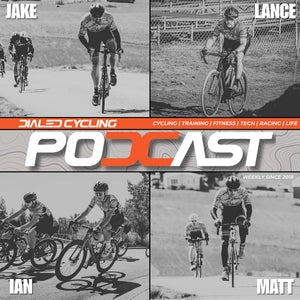
The Rundown: This bonus podcast comes from a listener request: how do you get through a time trial well? With a local season-opening 20K time trial on the calendar, the guys go through pacing, power numbers, aero position, course knowledge, wind, passing etiquette, fueling and warm-ups. They also explain the difference between the traditional time trial class and the Eddy class, which keeps things to road bikes and standard gear, and they place a couple of friendly bets on their own results. It's practical, conversational, and full of lessons learned the hard way. Read on for the highlights, then hit play above for the full conversation.
Dialed Podcast 53 recap
Is a time trial real racing?
Matt opened with the big question: does time trialing feel like real bike racing? The guys landed firmly on yes. Evan pointed out that if it's a stage in the Tour de France, it counts, and he leaned on the old line that Eddy Merckx called the hour record the hardest thing he ever did on a bike. Jake compared it to asking whether a sprint triathlon is a race.
Lance admitted he's not a great time trialist and that equipment can make it feel a little less pure, since a disc wheel, speed suit and aero helmet can buy real speed. Evan's take was that time trials are the breeding ground for excuses.
Traditional class versus the Eddy class
Jake explained that the Eddy class, named for Eddy Merckx, is the simplest race to describe: bring your road bike and ride the distance as hard as you can. It's growing in popularity and was expected to be the biggest category at the Jack Frost time trial near Portland, since it takes away the intimidation of showing up without a time trial bike.
The guys went through the rules, including limits on wheel depth and no aero helmets or clip-on aerobars. They noted the line is getting blurry, since some road helmets are very close to aero helmets, and Jake said he'd be wearing an aero road helmet that is completely legal. They also talked about the usual 20K and 40K distances.
Pacing, power and the negative split
Jake's first tip was to use a power meter and know your FTP, because the classic mistake is hearing "go" and dropping the hammer, then fading badly later. That sets up a positive split, where you finish slower than you started. A negative split means going faster in the second half.
Evan admitted he used to positive split every race out of fear of not emptying himself. Jake likes to start a few watts under FTP and build, while Matt said accelerating out of the start and corners is worth a small dig. The guys agreed nobody has this fully figured out, and that you shouldn't sandbag the first half just to claim a negative split.
Wind, aero position and the road bike tuck
On a windy day, Matt's advice was to trust your power number even when the headwind is demoralizing, and to ride a little harder into the wind, the same way you would on a hill. Knowing which way the wind will blow at what time of day helps you plan.
The guys also talked position. Shrugging your shoulders and tucking your head can save real watts, and the body is the biggest part of aero drag. On a road bike, they discussed getting the elbows in, forearms on the bar and the supinated hand position, plus the higher forearm angle some triathletes use. Jake shared how a teammate makes himself so small on a road bike that he beat riders on full time trial gear.
Know the course, keep your head up, pass politely
Matt recommended knowing the course, riding it hard once beforehand if you can, and knowing where the finish line is so you can empty the tank at the end. Jake added that you should take corners smoothly without crossing the yellow line, and keep your head up, because riders get tunnel vision and miss turns or other cyclists. Evan told a story of a bad crash from a time trial long ago.
On passing, the guys agreed to call out early with "on your left," and for the rider being passed to hold a straight line toward the right. Evan said responsibility is shared, and that triathlons could learn a lot from how cycling time trials are organized.
Calibration, fueling and warm-up
Jake reminded everyone to calibrate the power meter before the race, and the guys compared indoor trainer numbers to outdoor power. They agreed trainer watts often read noticeably lower than what you can produce outside, and that you shouldn't let a guessed FTP cap you if you feel good.
For race morning, Matt keeps it simple with a bagel, toast or banana and water, timed about an hour out, and was weighing whether to skip caffeine because of recent sensitivity. Lance said he'd take caffeine in a gel or tablet form. For warm-ups, Jake spends twenty-odd minutes on a portable trainer, rides some outside openers, and lines up about two minutes before his start. Lance does something similar.
The Backpedal: wagers on our own TT
The guys closed by looking ahead to their own race. Matt and Jake set up a toe-to-toe bet, with Jake in the Eddy class and Matt on full time trial gear, and the loser buys sparkling water for the podcast. Evan floated a second side bet, and Lance was hoping to just break forty minutes while feeling beat up.
Matt said breaking thirty minutes would make him super pumped, and the guys talked about how the Jack Frost TT works as a team points opportunity. They wrapped by saying it was proof they can talk about anything for far too long.
Listen to the full podcast
This recap only scratches the surface. Hit play on the player above, or find Dialed Podcast 53 wherever you get your podcasts.
More Gear From This Podcast
Talk to the guys
Got a question or an idea for the show?
Ask us anything about the podcast, pitch a topic for a future episode, send general feedback, or ask about gear. We read every one.