

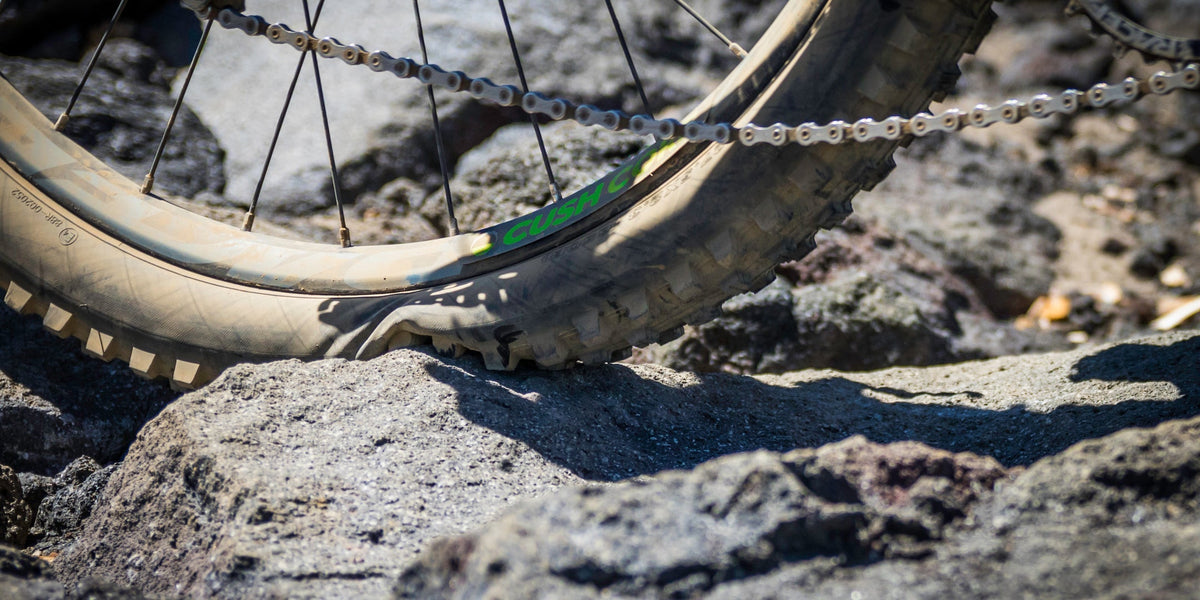
CushCore, unboxed and installed on camera
If you ride rocky trail on tubeless tires and keep choosing between enough pressure to protect the rim and little enough to grip, CushCore is worth a look. It is a foam insert that lives inside a tubeless tire and supports it when you need it most. Pick the version that matches your tire width and how hard you ride.
We unboxed a set, reviewed it, and walked through the full install on our YouTube channel in January 2021. The question we asked then still holds: do better cornering, more support and a calmer ride over rough ground interest you? If so, we think you will like these a lot.
What an insert actually does in there
Picture the last time you heard the rim ping off a square edged rock. The tire squashed all the way down and the wheel took the hit. Then picture a fast turn where the tire felt like it was folding under you.
Those are two different problems, and CushCore says its insert handles them at two different stages. As the tire starts to squash, CushCore says it supports the sidewalls so the tire rolls less in corners. When a hit squashes the tire all the way, the insert is between the rim and the rock, and CushCore says that is where it protects the rim and helps prevent flats.
The first part is the one people tend to miss. It is easy to think of an insert as just a rim bumper, but CushCore pitches it just as hard as sidewall support, which is what lets you drop pressure without the tire going vague in a turn.
It is not a run flat.CushCore's own words. It can limp you home, but plug the tire like any other tubeless setup.
What CushCore claims
CushCore says the insert adds 35 percent more sidewall stiffness, which is how it keeps the tire from squirming at low pressure.
CushCore says it reduces impact force from big hits by 50 percent and improves suspension performance by 16 percent.
CushCore claims a 12 percent smoother ride and 3 percent less rolling resistance.
Source: cushcore.com. These are the manufacturer's figures. We have not seen the test method behind them.
Which CushCore fits your bike?
CushCore makes several versions, and the right one comes down to tire width and how much protection you want to carry. All of the figures below come from CushCore's own product pages.
- ProCushCore calls it the best choice for most wheels, terrain and riders. It comes in 27.5 and 29 inch, for 2.1 to 2.6 inch tires on 22 to 35mm inner rim widths.
- TrailIt sits between Pro and XC on weight and performance and covers the same 2.1 to 2.6 inch tire range as Pro.
- XCThis is the lightweight version for cross country racing, light trail riding and less aggressive riders, built for 1.8 to 2.4 inch tires.
- PlusIt is made for plus size tires and wider rims: 2.6 to 3.0 inch tires on 32 to 45mm inner rims.
- GravelIt fits 33 to 46mm tires on 19 to 26mm inner rims, and CushCore lists it at 120 grams.
Every version comes with valves in the box. CushCore says its valves are designed to let you inflate and deflate with the insert in place, so use the ones that come with it. We carry CushCore Tire Inserts in several of these sizes, and stock moves, so check the product page for the size you need.
Before you install
- Confirm you are running tubeless. CushCore says it only works with tubeless setups, so it needs sealant.
- Watch the install first. CushCore says a first install should take no more than 30 minutes, and five to ten once you have done a few.
- On an asymmetric rim, CushCore says to start with the bead farthest from the rim channel, so the last bead goes on next to the channel where it is easier to seat.
- Add fresh sealant. We used Orange Seal Endurance in the video.
CushCore also makes a tool it calls the Bead Dropper for pushing the bead down into the rim channel, both going on and coming off. If your tires fit tight, that channel is your best friend, because a bead dropped into the center of the rim has more slack to work with than one stuck up on the shoulder.
The rim protection is the reason people buy it. It sits between the rim and the rock when the tire bottoms out.
The sidewall support is the reason people keep it. It lets the tire hold its shape in a turn at pressures that would feel vague without it.
Pick the version for your tire, not the heaviest one on the shelf.
Common questions
Does CushCore work with tubes?
No. CushCore says its inserts only work with tubeless setups and require tubeless sealant.
Can you ride flat on CushCore?
CushCore says it is not intended to be a run flat tire. Short limp home rides are possible with less risk of rim damage, and CushCore recommends tire plugs for trailside repair.
Do CushCore inserts come with valves?
Yes. CushCore's product pages list one valve with each single insert and two valves with a full set.
Is there a CushCore insert for gravel bikes?
Yes. CushCore Gravel fits 33 to 46mm tires on 19 to 26mm inner rim widths, and CushCore lists it at 120 grams.
Not sure which size you need?

Every tire insert we carry, CushCore included, is on one page, and we ship nationwide. Pick yours by wheel size, tire width and inner rim width. If you want us to install it, that is billed bench work, so ask for a price when you come in.
Shop tire insertsYou get lower pressure and fewer pinged rims from the same tire.