

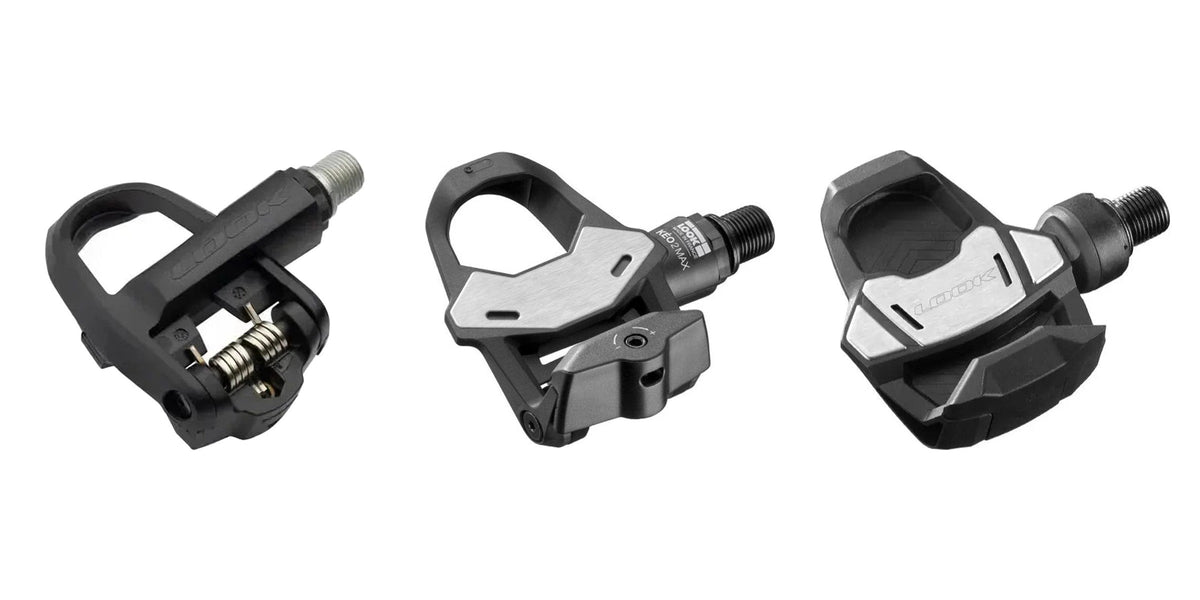
Which Look KEO pedal should you buy?
For most road riders, the Look KEO 2 Max family is the place to start, with a 500 mm² stainless steel plate under the cleat. Pick the KEO Classic 3 if you are new to clipless, and the KEO Blade if you race or want Look's widest, lowest platform.
All three take the same Keo cleat, so the choice comes down to three things: the platform under your foot, how release tension is set, and weight. Every number in this guide comes from Look's own spec pages, checked on October 28, 2026.
The Classic 3 is Look's entry road pedal. Release tension adjusts from 8 to 12, so you can start light while you learn to clip out and turn it up later.
The KEO 2 Max puts a 500 mm² stainless steel plate under the cleat at 130 g a pedal, and Look calls it the pedal for gran fondos. The 2 Max Carbon has a carbon body and weighs 125 g.
The KEO Blade holds the cleat with a carbon or composite blade instead of a metal spring. It has the largest platform of the three, 705 mm² and 64 mm wide, and the lowest stack, 14.8 mm with the cleat.
Specs from Look's product pages at lookcycle.com, checked October 28, 2026.
What is the difference between the Classic 3, 2 Max and Blade?
Look builds its KEO road pedals two ways. The Look KEO Classic 3 and the KEO 2 Max family hold the cleat with a metal spring. You set release tension with an adjuster at the back of each pedal, on a scale from 8 to 12.
The Look KEO Blade family replaces the spring with a carbon or composite blade. The blade you install sets the tension, at 8, 12, 16 or 20 Nm, and Look says a swap takes under 30 seconds with one dedicated tool. Beyond that, the models differ in platform, stack and weight. Here is how Look lists each one.
| Spec | KEO Classic 3 | KEO 2 Max | KEO 2 Max Carbon | KEO Blade |
|---|---|---|---|---|
| Platform area, mm² | 400 | 500 | 500 | 705 |
| Platform width, mm | 60 | 60 | 60 | 64 |
| Stack with cleat, mm | 17.8 | 17.3 | 17.3 | 14.8 |
| Weight per pedal, g | 140 | 130 | 125 | 115 |
| Pair with cleats, g | 350 | 328 | 312 | 300 |
| Platform material | Composite | Stainless steel | Stainless steel | Stainless steel |
| Body material | Composite | Composite | Carbon | Carbon |
All four sit at a 53 mm Q factor, which is how far out from the crank your foot sits. The KEO Blade also comes in a 56 mm version for riders whose fit calls for a wider stance.
Is the Look KEO Blade worth it over the 2 Max?
The Look KEO Blade gives you 41 percent more platform than the KEO 2 Max, 705 mm² against 500 mm². It is 4 mm wider, sits 2.5 mm lower, and weighs 15 g less per pedal. Look says the wider support spreads pressure evenly under the foot and helps reduce hot spots.
Our take: if you ride for fitness and fondos and set your tension once, the 2 Max does everything you need. If you race, sprint, or want to tune release by swapping blades, the Blade is the better pedal. Look rates each blade by how hard you have to twist to release.
Four blades, from easiest to hardest to release
- 8 Nm blade
- 4 kg
- Approximate release force
- Look's pick for beginners and leisure riding
- 12 Nm blade
- 6 kg
- Approximate release force
- Look's pick for regular road riding
- 16 Nm blade
- 8 kg
- Approximate release force
- Look's pick for experienced riders and hard training
- 20 Nm blade
- 10 kg
- Approximate release force
- Look's pick for racers and sprinters
Release force and rider picks from Look's KEO Blade product page, checked October 28, 2026.
We carry the Look KEO Blade in 53 mm with either the 8 Nm or the 12 Nm blade installed, plus a 12 Nm version in 56 mm. If you are torn between two tensions, start with the lower one. Moving up later only takes a different blade, and Look sells all four as replacement kits for the KEO Blade.

Look's photo of the KEO Blade box contents shows two pedals, a pair of gray Keo Grip cleats, cleat bolts and washers. The gray cleat gives 4.5 degrees of float, so the Blade is ready to ride once the cleats are on your shoes.
What do the Carbon, Ceramic and Vision versions add?
Each upgrade changes one part of the pedal and keeps the rest.
The Look KEO 2 Max Carbon swaps the composite body for carbon. The platform, stack and tension range stay the same as the 2 Max, and the weight drops from 130 g to 125 g a pedal.
The Look KEO Blade Ceramic keeps the Blade's 705 mm² platform and runs on ceramic bearings with a carbon blade. Look rates the bearings at 18 percent less resistance than steel and says they last four to six times longer. It ships with the 12 Nm blade, in 53 mm or 56 mm.
The Vision models add rear facing lights to the pedal: the Look KEO 2 Max Vision and the Look KEO Blade Ceramic Vision. Look says the lights are visible from up to 1 km in daylight, with four modes, up to 40 hours of battery and a two hour charge over USB-C.
Which Look Keo cleat should you use?
Every KEO pedal in this guide takes the same three bolt Keo cleat, and Look ships each one with Keo Grip cleats. The cleat color tells you the float, which is how far your heel can swing while you are still clipped in.
- Black Keo cleat: 0 degrees of float.The black Look Keo cleat holds your foot in one fixed position. It suits riders who want a locked in feel and know their cleat position is right.
- Gray Keo cleat: 4.5 degrees of float.The gray Look Keo cleat gives a little room to move, and it is the one in the KEO 2 Max and KEO Blade boxes. It is a sensible starting point if you are unsure.
- Red Keo cleat: 9 degrees of float.The red Look Keo cleat gives the most freedom. Choose it if your knees prefer to move through the pedal stroke.
Cleats are a wear item. We stock the Look KEO Grip Cleat Tri-Material in gray and red. New to clipless pedals altogether? Our guide to choosing clipless pedals and shoes covers the basics first.
Common questions
What is the difference between the Look KEO 2 Max and the KEO Blade?
The KEO 2 Max holds the cleat with a metal spring and has a 500 mm² stainless steel platform at 130 g a pedal. The KEO Blade uses a carbon or composite blade for tension, with a 705 mm² platform, 2.5 mm less stack and 115 g a pedal.
Do all Look KEO pedals use the same cleats?
Yes. The Classic 3, 2 Max and Blade families all take Look's three bolt Keo cleat, and each ships with Keo Grip cleats in the box.
Which Look KEO pedal is best for beginners?
The KEO Classic 3 is Look's entry road pedal, and its tension adjusts from 8 to 12 so you can start light. On the Blade, Look recommends the 8 Nm blade for beginners and leisure riding.
How much do Look KEO pedals weigh?
Look lists the KEO Classic 3 at 140 g a pedal, the KEO 2 Max at 130 g, the KEO 2 Max Carbon at 125 g and the KEO Blade at 115 g.
What do the Look Keo cleat colors mean?
The color shows the float. Black gives 0 degrees, gray gives 4.5 degrees and red gives 9 degrees.
Before you order Look pedals

Start with how you ride. Long road miles point to a KEO 2 Max, racing points to a KEO Blade, and a first clipless setup points to the KEO Classic 3. Look's road pedal pages have the full specs for every model.
Questions about shoes, cleats or tension? Ask us. If you want the lab to install your pedals and set up your cleats, that is billed bench work.
Shop Look PedalsChoose the platform that matches your riding, set the tension you are comfortable with, and you will rarely think about your pedals again.