

What bike tire pressure should you run?
The right bike tire pressure is the lowest pressure that keeps your tire, your rim and your handling safe, not the maximum printed on the sidewall. On real roads, running a little too low costs almost nothing, and running too high costs real speed and comfort.
That is the short version. The long version depends on what you weigh with the bike, how wide your tires measure, what you ride on, and what your rim allows. This guide walks through each one with the published test data behind it, so you know where every number came from.
The Lab has tested and ridden a lot of tires chasing the right number. The tool we keep coming back to is the Silca Pro Tire Pressure Calculator. It has been a reliable starting point for our own riding and for the racers on the Dialed Cycling Team, from easy weekend miles to getting set up for race day. We will show you how to use it well, and the few checks no calculator can do for you.
What it cost to miss the ideal tire pressure by 10 psi in each direction
- 10 psi too low
- 1 W
- Extra power needed, about
- Running 10 psi under the ideal pressure barely cost anything.
- 10 psi too high
- 9 W
- Extra power needed, about
- Running 10 psi over the ideal pressure cost about nine times as much.
From Silca's article "Tire Pressure Calculator Explained" at silca.cc, read October 30, 2026. Tested on Continental GP 4000 II tires.
Why is lower tire pressure often faster on real roads?
Lab rolling resistance tests run tires on a smooth steel drum, and on a drum, harder is always faster. Bicycle Rolling Resistance measured the Continental Grand Prix 5000 S TR in 25 mm at 11.0 watts at 73 psi and 8.8 watts at 109 psi. If roads were steel drums, you would pump to the sidewall maximum and be done.
Roads are not drums. Every crack, patch and bit of chipseal pushes the tire up, and a hard tire passes that bump into the bike and into you. Silca calls this energy loss impedance. In its field testing, rolling losses dropped as pressure went up until a point Silca calls the breakpoint. Past the breakpoint, the vibration losses grew faster than the tire saved, and the bike got slower.

Silca ran that field test on five surfaces, from milled pavement to new asphalt, on 25 mm Continental GP4000s II tires and Zipp 404 wheels with a 190 lb system weight. Every surface showed a breakpoint, and rougher surfaces put it at a lower pressure. You can read the method in Silca's rolling resistance and impedance article.
Independent research points the same way. In a 2024 model of riding on rough roads, researcher Miles M. Turner found that the resistance from road roughness is larger than tire rolling resistance on moderately rough roads, and larger than aerodynamic drag on very rough ones. He also found that roads smooth enough to ignore it make up less than 10 percent of roads in most places. The paper is on arXiv.
"It is always better to be too low than too high."Silca's advice on bike tire pressure, based on its breakpoint testing: 10 psi under the ideal pressure cost about 1 watt, and 10 psi over cost about 9.
How do tire width and tire choice change your pressure?
At the same pressure, a wider tire rolls easier. Bicycle Rolling Resistance tested the Continental Grand Prix 5000 S TR in four widths, and the 32 mm tire beat the 25 mm at every shared pressure. A wider tire also holds the same weight with less pressure, so the width you choose moves your number a lot.
| Spec | 25 mm | 28 mm | 30 mm | 32 mm |
|---|---|---|---|---|
| Rolling resistance at 73 psi, watts | 11.0 | 10.3 | 9.8 | 9.4 |
| Pressure the tester suggested, psi | 80 | 72 | 69 | 65 |
| Rolling resistance at that pressure, watts | 10.4 | 10.2 | 10.0 | 9.8 |
The gaps are small, and the tester expects the extra weight and air drag of a wider tire to offset some of them. A 2025 lab study in the Journal of Science and Cycling found something similar: on GP5000 tires from 23 to 32 mm, wider tires coasted farther, but the gains leveled off past about 30 mm. The same study found wider tires cut vibration substantially. That comfort is the part you feel on every ride.
The tire model matters too. Escape Collective tested 10 road tires on a real road in 2026 and found about 8 to 10 watts between the fastest and the slowest. The three fastest were also the most fragile. Within a normal range, the testers found pressure changed comfort more than speed, so their advice was to choose the tire first and then set pressure for how it feels.
Our take: for most road riders, a quality 28 to 32 mm tire like the Continental Grand Prix 5000 S TR or the Vittoria Corsa N.EXT tubeless at a sensible pressure will ride better than a narrow race tire pumped hard. Silca also notes that a more supple, higher quality casing raises the breakpoint, so a fast casing can carry a little more pressure before it starts costing you.
Tubeless, latex, TPU or butyl: does the tube change anything?
What sits inside the tire changes how much energy it wastes. Bicycle Rolling Resistance averaged three fast 25 mm road tires, the Vittoria Corsa Speed G+ 2.0, Schwalbe Pro One TT and Continental Grand Prix 5000 S TR, and tested each setup at four pressures.
Average of three 25 mm road tires on a steel drum, lower is faster
- Tubeless with sealant
- 9.1 W
- Rolling resistance per tire
- The fastest setup in the test at every pressure.
- Fastest
- Latex inner tube
- 9.4 W
- Rolling resistance per tire
- Nearly as fast as tubeless in this test.
- Butyl inner tube
- 11.6 W
- Rolling resistance per tire
- The standard black tube was the slowest of the three.
Bicycle Rolling Resistance, "Top 3 Fastest Tubeless vs Tubes," published February 25, 2022, read October 30, 2026.
The gap grows as pressure drops. At 60 psi, the same test measured 10.6 watts for tubeless, 11.0 for latex and 14.2 for butyl. That matters because the lower pressures that ride best on real roads are exactly where a butyl tube hurts most. TPU tubes sit in between: in the tester's separate TPU tube comparison at 80 psi, the best TPU tube came within a tenth of a watt of latex, and most TPU tubes ran 11.0 to 11.7 watts.
Gravel and mountain tires show the same pattern. Bicycle Rolling Resistance found tubeless beat butyl by 2.8 watts per tire at high pressure and 5.1 watts at extra low pressure across eight gravel tires. On a 29 x 2.2 inch mountain bike tire at 25 psi, tubeless measured 17.4 watts, latex 18.5 and butyl 22.4.
If you are weighing the switch, our post on road tubeless covers who it suits and who it does not, and the guide to tubeless valve stems covers picking the right length.
What tire pressure for road, gravel and mountain bikes?
The physics is the same on every bike. What changes is the surface, the tire volume and how much grip you need.
Road bike tire pressure
The oldest method still worth knowing is Frank Berto's tire drop rule. Berto measured 50 road tires at seven pressures and eight loads, and recommended a pressure that lets the tire compress about 15 percent of its width under load. For a 200 lb rider and bike, his table works out to about 88 psi on a 25 mm tire, 76 psi on a 28 mm tire and 60 psi on a 32 mm tire.
Treat those as a starting point, not gospel. Berto himself called his numbers approximate, and his chart dates from an era of much narrower tires. Jan Heine of Bicycle Quarterly has written that the 15 percent figure is arbitrary and that rough roads call for less air. Both agree on one thing: run the front lower than the rear, because the rear wheel carries more of your weight. Berto assumed about 45 percent of the load on the front.
Here is what the Silca calculator gave us on October 30, 2026 for a 170 lb system weight on 28 mm tubeless tires with a mid-range casing, at a moderate group ride pace. Watch how much the road surface moves the number.
Rear tire pressure Silca recommended for three road surfaces
- Poor pavement or chipseal
- 69 psi
- Rear tire, front 67 psi
- Worn pavement with some cracks
- 75 psi
- Rear tire, front 73 psi
- New pavement
- 79 psi
- Rear tire, front 77 psi
Silca Pro Tire Pressure Calculator, run by the Lab on October 30, 2026. 700C wheels, 48/52 road weight split.
Notice that two of those three results sit above 72 psi. That is fine on a hooked rim rated for it, and not allowed on a hookless rim with a 28 mm tire. More on that below.
Gravel bike tire pressure
On gravel, width and pressure matter more than the tire you pick. Continental worked with the German Sport University Cologne on a gravel tire study, reported by Escape Collective in August 2026, and found that tire model, tread and casing had little effect on what they measured, while width and pressure had large effects. Continental did not publish the pressures, so we cannot give you their numbers.

For a 190 lb system weight on 40 mm tires, the Silca calculator gave us 38 psi rear and 36.5 psi front on Silca's Category 2 gravel setting. Moving to a 45 mm tire on the same road dropped it to 31 psi rear and 30 psi front. If you ride mixed and loose surfaces, tires like the Schwalbe G-One RS and the Vittoria Terreno T30 are two of the gravel tires we carry for that kind of riding.
Mountain bike tire pressure
Berto was clear that his 15 percent rule does not apply to mountain bike tires. Knobs, wide tires on narrower rims and the need for traction push mountain bike pressure well below any road formula. Start from a calculator, then adjust on your own trail: if the tire squirms in corners or you feel the rim hit rocks, add air, and if the bike skips and bounces off roots, take some out.
What is the maximum tire pressure on a hookless rim?
This is the one part of tire pressure that is not a preference. A hookless rim has straight inner walls with no hook to hold the tire bead, so it relies on the tire fitting tightly and on staying under a pressure limit. The ETRTO, the European body that sets tire and rim standards, caps pressure on hookless rims by tire width. Schwalbe and ENVE both publish those limits. Some rim makers rate their rims differently based on their own testing, so go by your rim maker's published limit, and if you cannot find it, use the ETRTO number.
| Tire width | Max, bar | Max, psi |
|---|---|---|
| 25 to 29 mm | 5.0 | 72 |
| 30 to 34 mm | 4.5 | 65 |
| 35 to 39 mm | 4.0 | 58 |
| 40 to 44 mm | 3.5 | 51 |
| 45 to 54 mm | 3.0 | 44 |
| 55 to 64 mm | 2.5 | 36 |
Two more rules apply to every wheel, hooked or hookless.
- Use the lower of the tire maximum and the rim maximum.Your tire and your rim each carry a maximum pressure. ENVE and Schwalbe both say the lower of the two is your limit, every time.
- A maximum is a ceiling, not a target.Zipp describes the pressure printed on its rims as a safety limit for keeping the tire on the rim, not a recommended riding pressure. ENVE recommends riding well below both the tire and rim maximums.
- Run only tire widths your rim maker approves.Hookless rim makers list the tire widths their rims accept, including a minimum, and Schwalbe says to use only those. ENVE notes the ISO and ETRTO guidance of at least a 29 mm tire on a hookless rim with a 25 mm internal width.
Should you trust a bike tire pressure calculator?
A good calculator beats guessing, and Silca's has earned its place at the Lab. It asks for your total system weight, your measured tire width, the surface, your speed, your bike type and the quality of your tire casing. Silca says tire construction, whether tubular, clincher or tubeless, does not change the ideal pressure, but it does change what pressure is safe.
Every calculator we looked at uses total system weight, and none of them publishes its full formula. Some ask for things others do not. The Zipp calculator asks for your rim type and internal width. The Rene Herse calculator asks whether you run tubes or tubeless. Silca's does not ask about your rim at all, so the hookless table above is your job to check.
Use the calculator for your starting number, then check it against your tire and rim limits, then ride it. A calculator cannot feel your bike. You can.
Is your pump gauge telling you the truth?
Probably not exactly. Silca says most new pumps are accurate to about 5 or 6 percent, that it has seen new pumps off by 7 or 8 psi in either direction, and that accuracy drops as a pump ages. When Outrider Components checked three pumps against a precise digital reference, one floor pump read 1.1 to 3.1 psi low and another read 9.1 to 16.6 psi high.

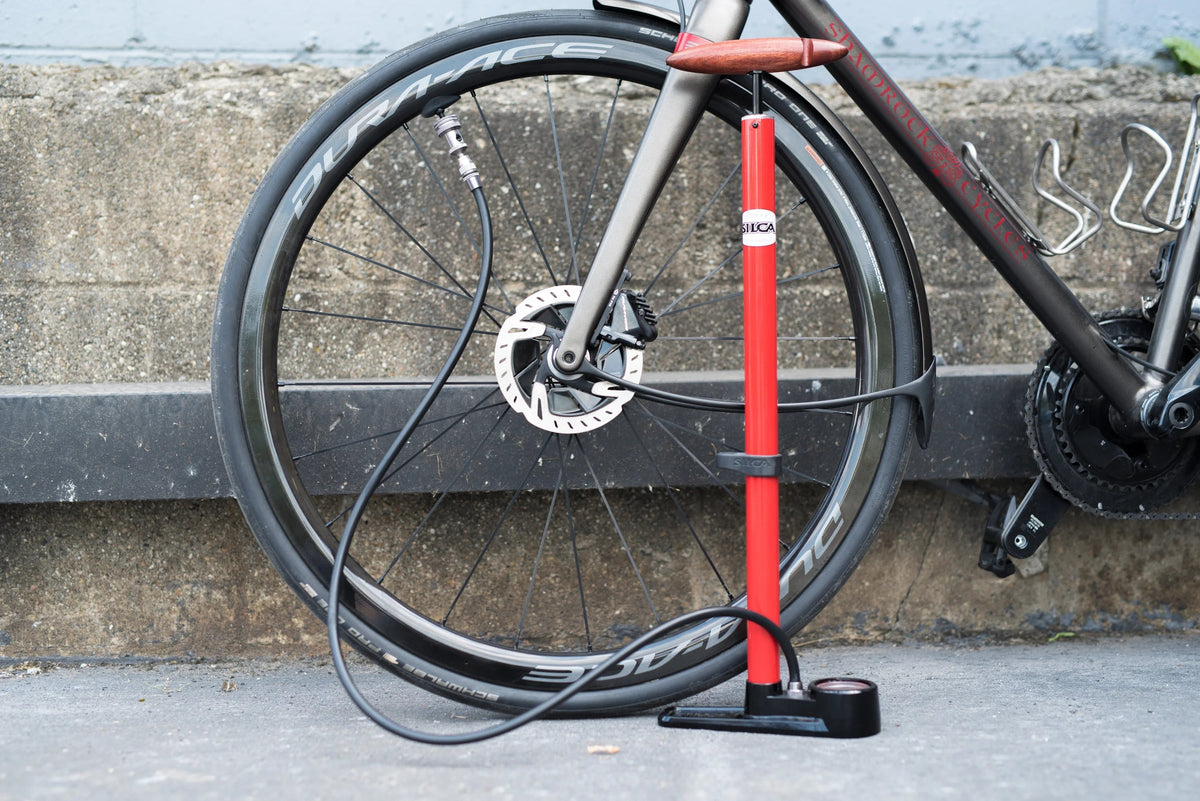
A floor pump gauge like the one on this Silca Terra gets you close. For a number you can repeat, check it with the same gauge every time, or with a dedicated digital gauge like the SKS AirChecker. Photo: Silca.
Two habits fix most of this. Use the same gauge every time, so your number means the same thing next week. And if you want a number you can trust, a dedicated digital gauge like the SKS AirChecker takes the pump out of the question. For the pump itself, the Silca Pista Plus is the classic, and the Silca Terra has a two stage gauge that gives half the dial to 0 to 30 psi, for wide, low pressure tires.
Then check before every ride, because tires leak. In a small test by Velo, tubes pumped to 80 psi were checked about a week later: the butyl tube read 73 psi, the TPU tubes read 72 and 76, and the latex tube read 53. Tubeless was left out because results varied too much to show a trend. If you run latex tubes, top them up every ride.
How to set your tire pressure, step by step
- Weigh yourself with the bike, bottles and gear you ride with. Calculators want total system weight, not body weight.
- Measure your tire width once it is mounted and inflated. The same tire measures differently on different rims.
- Run the Silca calculator with an honest surface and speed for the ride you actually do.
- Check the result against your tire maximum, your rim maximum and, on a hookless rim, the width limit in the table above. Use the lowest.
- Ride it on your usual roads and adjust in small steps. If you are unsure, go a little lower rather than higher.
- Write your number down and check it before every ride with the same gauge.
Bike tire pressure questions
What PSI should road bike tires be?
There is no single number. Frank Berto's tire drop tables put a 200 lb rider and bike at about 88 psi on a 25 mm tire, 76 psi on a 28 mm tire and 60 psi on a 32 mm tire. Wider tires, rougher roads and lighter riders all go lower, and a hookless rim caps 25 to 29 mm tires at 72 psi.
Is it better to run tire pressure too low or too high?
Too low, within reason. In Silca's breakpoint testing on new asphalt, running 10 psi under the ideal pressure cost about 1 watt, while running 10 psi over cost about 9 watts. Too low becomes a problem once the tire squirms in corners or the rim hits the ground.
What is the max tire pressure on a hookless rim?
Under the ETRTO standard, a hookless rim allows 72 psi (5 bar) for 25 to 29 mm tires, 65 psi for 30 to 34 mm, 58 psi for 35 to 39 mm and 51 psi for 40 to 44 mm. If your rim maker publishes a different limit, follow the rim maker, and never exceed your tire's own maximum.
Should front and rear tire pressure be different?
Yes. The rear wheel carries more of your weight, so the rear tire needs a little more pressure than the front. Frank Berto assumed about 45 percent of the load on the front wheel, and the Silca calculator also gives a lower front pressure than rear.
How often should I check my bike tire pressure?
Before every ride. In a small test by Velo, tubes pumped to 80 psi read 72 to 76 psi for TPU, 73 psi for butyl and 53 psi for latex about a week later. Use the same gauge every time so the number stays consistent.
Do wider bike tires roll faster?
At the same pressure, yes. Bicycle Rolling Resistance measured the Continental Grand Prix 5000 S TR at 11.0 watts in 25 mm and 9.4 watts in 32 mm at 73 psi. At each width's suggested pressure the gap shrinks to 10.4 against 9.8 watts, and a wider tire adds some weight and air drag.
Before you pump up for your next ride

A floor pump with a gauge you trust is the one tool that makes every number in this guide useful. We carry Silca floor pumps, mini pumps and electric inflators, plus the SKS AirChecker digital gauge, so you can set the same pressure every ride.
Questions about which tire width or pressure suits your bike and your roads? Ask us.
Shop Pumps and GaugesFind your starting number, check it against your tire and rim, then let the road tell you the rest.