


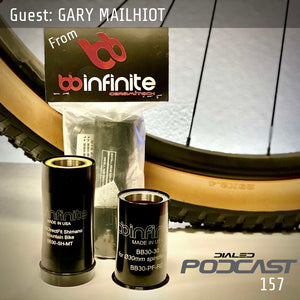
The Rundown: Gary Mailhiot of BBinfinite joins the guys for a long conversation about how bottom brackets and pulley wheels actually work. He explains why the company builds its bottom brackets as one machined piece, how bearing quality and fit matter more than a bearing that spins forever, and why ceramic bearings suit wet climates like the Pacific Northwest. The guys also catch up in The Backpedal, with a muddy mountain bike race and a snowed-in week, and run through the UAE Tour in Leadout News. Read on for the highlights, then hit play above for the full conversation.
Dialed Podcast 157 recap
The Backpedal: a mountain bike race, a snow week and a long day on the trainer
Lance kicked off The Backpedal with a mountain bike race near Tacoma, run time trial style on single track and set up to be COVID safe. He raced the Cat II field and admitted the guys were right to give him some sandbagging grief, since he thinks he might have been competitive a category up. He also enjoyed pegging his heart rate for close to fifty minutes. Chris Surratt came along to race as well.
Matt has settled into a steady triathlon training routine, mostly on Zwift, with a few runs in the snow and some pool time when it was open. He also pedaled around on a mountain bike while coaching cross country practice. Gary's snowed-in week in Little Rock ended with a long trainer session with a friend, and he stopped well short of the six-hour goal. His soul, he said, was dying.
Leadout News: crosswinds at the UAE Tour
Lance ran through the early stages of the UAE Tour. Stage one was full of crosswinds that split the peloton into several echelons, and it made for beautiful but brutal racing. Mathieu van der Poel took the stage from the front group, while Chris Froome and Adam Yates got caught in a late echelon and lost a big chunk of time.
He also mentioned that van der Poel's team pulled out of the race after a positive test, and that van der Poel was already pointing toward the spring classics. Stage two was a short time trial that went to Filippo Ganna, with Pogačar sitting in the overall lead.
Gary's path from machinist to bottom bracket maker
Gary has a machining background in automotive and motorcycle work and worked as a bike mechanic when PressFit bottom brackets were taking over. A brand new frame arrived with a bag of plastic adapters, and the build barely spun, which convinced him there had to be a better way. His answer was one machined piece that goes in from a single side, so the bearings stay perfectly aligned.
Gary and his business partner now run the operation with four employees and two CNC machines, and everything is made in the USA except the anodizing. Gary spoke passionately about American manufacturing and the shortage of young machinists. He also explained the name: the "infinite" is about spin and about serviceability, since the bearings can be replaced and the bottom bracket moved from bike to bike.
Matching cranks to bottom bracket standards
Matt asked which crank works best with which bottom bracket standard. Gary said many people choose a crank first and force it into a frame, which causes trouble. Shimano designed BB86 around its own 24 millimeter spindle, so legacy cranks such as Shimano, GXP and Campagnolo Ultra Torque are the natural fit there, and a 30 millimeter spindle takes more cleverness.
He is a big fan of BB30 for those older cranks, because the bearings sit outboard of the frame and the frame has less say in how they perform. When the bearings sit inside the shell, the frame's tolerances squeeze them, so a good bottom bracket needs a design that can forgive that. Gary reminded the guys that the bottom bracket carries every watt you make, so drag matters as much as it does at the hubs.
Why "spins forever" is only part of bearing quality
Matt asked how to explain bearing quality to people who judge a part by how long it spins. Gary said spin matters, but a fidget spinner spins forever too, and the real questions are how it got there. Hybrid ceramic bearings pair silicon nitride balls with a steel race, and that ball is so hard it will wear out a poorly treated race, which is why cheap ceramics so often disappoint.
He said the race needs the right heat treatment and polish, and the internal tolerance of the bearing decides how freely it runs. BBinfinite works with a major Japanese bearing maker to specify the fit and grease rather than taking stock bearings. Gary also described a half-grip bearing fit that lets the bearing flex slightly under too much pressure rather than shutting down.
Ceramic versus steel, sealing and maintenance
For a cyclocross or mountain bike, Gary said sealing is always a balance, because aggressive seals slow you down and nothing keeps water out entirely. BBinfinite uses a low-contact seal, and he recommended ceramic bearings for wet climates like the Pacific Northwest. They handle water intrusion better, and the company's fourth-generation ceramics and tungsten disulfide coating came out of lessons learned with riders in Belgium.
His maintenance rule of thumb is to service about every 40 hours on a mountain bike or cyclocross bike and about every 2,000 miles on a road bike. After a ride, spin the crank and listen and feel for anything off rather than tearing things down every time. Neglected wheel bearings, he added, are among the things he sees most often.
Grease, pulley wheels and where the watts come from
The guys asked about lubricant. Gary said small ball bearings want a low-viscosity grease, because a thick, sticky grease can make the balls slide rather than roll. He suggested filling only about half the bearing and rolling it around to spread the grease, and said more grease is often a mistake.
On the watts question, he called every drivetrain gain incremental and said what you are really buying is performance that lasts, since serviceability keeps it from degrading. He thinks the stock pulley wheels from the big component makers are the easiest place to feel a difference, and said riders often notice within a few feet of pedaling. He also said BBinfinite pulleys are molded into Delrin, with no radial compression on the bearing.
Creaks, frame tolerances and installing a bottom bracket
Gary said a bike should never simply creak, and the one-piece design is aimed at that. Tolerances vary between frames, so he builds in a little room for an overly tight shell. He has even reamed out a few frames for customers, and he praised T47 as a roomy, threaded standard that never over-compresses the bearings.
He had good things to say about the frame quality at several well-known brands but kept the worst offender to himself. Matt also asked about the popping sound when you press one in. Gary said that popping is the anaerobic retaining compound curing as the oxygen gets squeezed out, and that it is a good sign, so have your press ready and keep driving it home.
Listen to the full podcast
This recap only scratches the surface. Hit play on the player above, or find Dialed Podcast 157 wherever you get your podcasts.
More Gear From This Podcast

Talk to the guys
Got a question or an idea for the show?
Ask us anything about the podcast, pitch a topic for a future episode, send general feedback, or ask about gear. We read every one.