



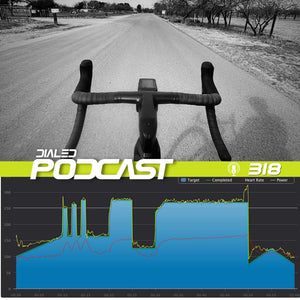
The Rundown: FTP has been the go-to number for cyclists and coaches for years, but is it still the right way to judge an athlete, or has it turned into a fish tale? The guys open with their weeks on the bike, including a very spicy gorge gravel pre-ride, then check in on Ghent-Wevelgem and the weekend's racing. The main topic covers how FTP is defined, why indoor and outdoor numbers differ, how often to test, and how watts per kilo and body size change what the number really means. Read on for the highlights, then hit play above for the full conversation.
Dialed Podcast 318 recap
The Backpedal: running, a hot gravel pre-ride and a very full week
Matt has been running a few miles nearly every day, which he says is the one sport you can sneak in between swim meet sessions when a bike ride is out of the question. Ian and Lance had a big week of a different kind. A group of about ten riders met up to pre-ride the roughly 70 mile medium course for the Gorge Gravel Grinder, and the pace was racing pace from the first minute. Ian came home with a training stress score of 318, nearly identical to the race he did a week earlier.
Lance logged close to 20 hours, most of it on his gravel bike. That included a Tuesday night gravel ride where three of them sat on a teammate's wheel while he did threshold intervals, and a long Wednesday loop out toward Scappoose that turned up some surprise steep ramps. Jake gave an update on his ongoing hip situation and the frustrations of trying to get medical offices to call back, and said his strength training is shifting toward something more cycling specific.
Leadout News: Ghent-Wevelgem and Catalunya
Lance walked through Ghent-Wevelgem, a Flanders classic with a reputation as a sprinter's race that still gets shaken up by two trips over the short, steep, cobbled Kemmelberg. Van der Poel attacked on the climb and took a small group with him, and two Lidl-Trek riders in that group worked him over with alternating attacks. In the final kilometer, Mads Pedersen jumped from the front and held off Van der Poel, who gave up at the line. The guys also noted how close the women's bunch sprint was, with the result taking minutes to sort out.
Looking ahead, they previewed the Tour of Flanders with Van der Poel and Van Aert on the start list and Pogačar skipping it for altitude work before the Giro. They also marveled at Tadej Pogačar's Volta a Catalunya, where he took several of the stages.
What FTP actually is, and how to find yours
Jake opened the main topic by defining functional threshold power as the most power you can hold for about an hour, though almost nobody tests for a full hour. Most people use a 20 minute effort multiplied by 0.95, or an eight minute test, and plenty of software now estimates it from your ride history. Ian explained the physiology behind it, with threshold being the point where lactate and acidity in the blood build faster than your body clears them, and why that makes FTP a handy stand-in for lab testing.
The guys also talked about the origins of the metrics we all use, with Andy Coggan's work behind FTP and normalized power, and the fact that terms like normalized power and TSS are tied to TrainingPeaks, which is why they do not show up in every app. Matt pointed out that an hour is somewhat arbitrary, and a number based on 30 minutes would work just as well as long as you use it consistently.
Indoor versus outdoor, and when to retest
Lance and Ian both see a gap of about 20 to 25 watts between their trainer FTP and what they can do on the road. The guys offered several reasons: it is easier to suffer outdoors, cooling is better, the bike moves around under you, and ERG mode holds you to a perfectly steady wattage with none of the natural micro-breaks of real riding. Ian's take is that it is fine to have two numbers, because your trainer workouts are based on a percentage of the trainer FTP.
On testing, Ian likes a test every five to six weeks at the end of an easy week, though he is careful not to schedule them too often since everyone ends up disappointed. Lance prefers to take his best 20 minute power from a hard group ride or race and multiply it by 0.95 rather than do a formal test. They also noted that people always feel like they could have gone one more step on a ramp test, but the data usually says otherwise.
Why FTP isn't the whole story
The conversation turned to why comparing FTP numbers between riders can mislead you. Body mass matters, so watts per kilo tells the climbing story much better. Aerodynamics matter too, and Jake pointed to a friend who is not enormous but gets remarkably slippery in the wind. Lance gave a good example of a teammate with a similar FTP who is lighter and will simply ride away from him on any climb longer than a couple of minutes, while on a flat stretch Lance can sit on his wheel without much trouble.
The guys also traded watts per kilo numbers from their own best years, with most landing somewhere between about 4.1 and 4.6. They tossed around pro numbers too, with Ian noting that a four watts per kilo rider can be competitive in the mid pack of a Cat 3 road race, and Lance mentioning that big gravel racers can have FTPs well north of 450.
Is FTP the right number for racing?
Ian questioned how often a road race actually rewards a steady hour of threshold power. Most road races are a mix of tempo in the pack, surges where everyone goes anaerobic, and a sprint at the end, so the number matters most for long climbs, solo breakaways and, as Matt noted, triathlon. Matt told the story of using power numbers in his Ironman days, when pacing to a set number and then running well felt almost like cheating.
They closed the topic by saying the number is useful but should not be an obsession. It is an excellent way to see whether your training is working, especially in the first few years when gains come quickly, and it keeps your intervals aimed at the right intensity. Ian said that by year four or five you are lucky to see a couple of percent, and that eventually the goal becomes simply holding on to what you have.
One Last Thing: videos, a road race and a trip
Matt shared that he had just posted a video on the Apple Vision Pro, with more swimming content planned, including swim power meter paddles and a heads-up display goggle. Ian said he is playing race promoter again and bringing road racing back to the Portland area with the Barton Park circuit race, and the guys chatted about how thin the local road calendar has gotten.
Lance mentioned a road race up in Washington that weekend, and Jake said he was headed to the Grand Canyon, Sedona and Las Vegas with his family, taking photos and getting some downtime.
Listen to the full podcast
This recap only scratches the surface. Hit play on the player above, or find Dialed Podcast 318 wherever you get your podcasts.
More Gear From This Podcast


Talk to the guys
Got a question or an idea for the show?
Ask us anything about the podcast, pitch a topic for a future episode, send general feedback, or ask about gear. We read every one.