

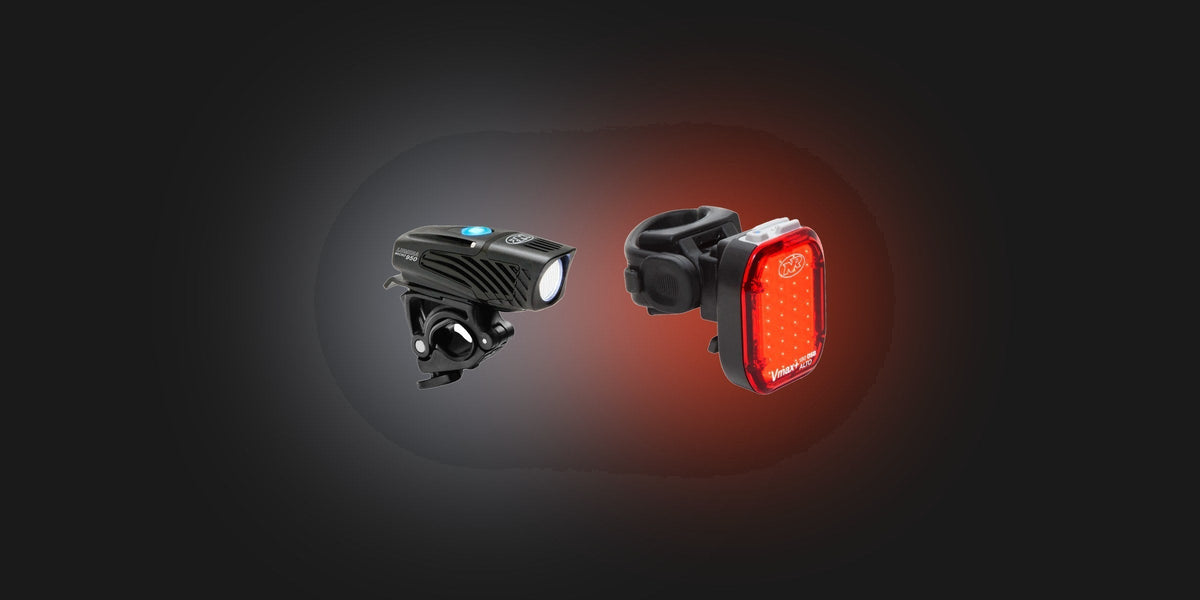
Is it okay to ride a bike at night?
Yes. Riding a bike at night is a lot of fun when you prepare for it. You need a front light bright enough to see the road or trail, a rear light so drivers see you, enough battery to outlast the ride, and friends who regroup.
Here in the Pacific Northwest it gets dark early all winter. When it is not raining, we want to ride outside, and that usually means riding after sunset. So our team and friends do it a lot, on the road and on the trail. Trails that see heavy use during the day are mostly empty after dark, which gives you a little more room to have fun and go a little faster, within reason.
We rewrote this page in October 2026 around what we have learned from those rides. The video we filmed on the same subject in December 2020 is further down.
A light to see with and a light to be seen with
A front light has two jobs at night, and a little blinky only does one of them. Drivers can see a small flashing light just fine. You cannot see the pothole with it.
Our post on being seen covers the first job: lights on every ride, flash during the day, and something on your feet that moves so drivers know you are a person on a bike. This post is about the second job. After dark you need a steady beam on the ground ahead of you, aimed low enough that it lights your path without blinding the person coming the other way.
On a night ride, having a front light with the right spread and brightness for the road or trail you are riding matters more than anything else you bring.Our first rule for riding a bike at night.
How many lumens do I need for night cycling?
It depends on how dark your route is and how fast you ride it. The lumen number on the box is the light's brightest mode. More light lets you see farther down the road, which matters more the faster you go, and it matters most on a trail with no ambient light at all.
NiteRider, the light many of our teammates and friends run, lays out its own lineup by exactly those conditions. Here is what NiteRider says each of the lights we carry is built for.
Lit streets and bike paths
The NiteRider Swift 450 tops out at 450 lumens. NiteRider pitches it for commuting, bike paths and well lit streets.
Where streetlights drop away
The NiteRider Swift 700 tops out at 700 lumens. NiteRider says it gives you more light than the Swift 450 once the street lighting thins out.
Commutes with some ambient light
The NiteRider Lumina Micro 950 tops out at 950 lumens. NiteRider pitches it for commutes, city streets and roads with some lighting.
Dark roads and faster rides
The NiteRider Lumina Micro 1150 tops out at 1,150 lumens. NiteRider pitches it for riders on darker roads or carrying more speed.
Long rides, gravel and trail
The NiteRider Lumina Boost 1400 reaches 1,400 lumens in its Boost mode. NiteRider pitches it for longer road, multi-surface and trail rides after dark.

Going by NiteRider's own guidance, a night ride that leaves the streetlights behind points to the Lumina Micro 1150, and a night ride that leaves the pavement points to the Lumina Boost 1400.
How long will a bike light last on a night ride?
This is the part that catches people. The big number on the box is the high mode, and the high mode is the one that runs out first. Every light lists a runtime for each mode, and the gap between them is large.
NiteRider lists those runtimes as approximate. The Lumina Boost 1400 runs 1 hour 30 minutes on High at 950 lumens and 3 hours on Medium at 500 lumens. So a three hour ride on the Boost 1400 means riding most of it on Medium and saving the brighter modes for descents and the dark stretches.
Plan the ride around the mode you will actually use, then leave some margin.
How we ride at night as a group
Most of our night riding happens with friends and teammates, and a few habits keep everyone coming home together.
- Everyone brings plenty of light, and many of us carry a spare light in a pocket in case someone else's light dies mid-ride.
- We have had a rider's light die completely on a group ride. The group stays together and gets that rider home on everyone else's light.
- We plan regroup points ahead of time, so everyone stops at the same places and nobody is off the back dealing with a problem alone.
- If we do not know the route well, we slow the pace down, because even familiar roads and trails look different in the dark.
Lights from Portland Design Works are good too. The PDW City Rover 700 and Io light set puts a front and rear light in one box, and we carry the PDW Danger Zone taillight as a rear light on its own.
The rear light, and why radar helps after dark
The rear light is for the driver behind you. The NiteRider Vmax+ 180 tops out at 180 lumens, and NiteRider lists 4 hours 30 minutes on high steady and 24 hours on low steady. If you want the front and rear in one box, the Lumina Micro 1150 and Vmax+ 180 combo pairs it with the Micro 1150.
At night the car behind you is the one you cannot see coming. A radar tail light like the Garmin Varia RearVue 820 alerts you to vehicles coming up behind you, often before you hear them. Our radar breakdown covers which Varia fits which rider.
What the law asks for in Washington
Washington front light rule
During the hours of darkness, a bike needs a lamp on the front that emits white light visible from at least 500 feet ahead.
Washington rear reflector rule
A bike needs a state approved red rear reflector visible up to 600 feet in a car's low beams. A red light or flashing LED taillight visible from 500 feet may be added to it.
Both rules come from RCW 46.61.780. The word "added" matters. In Washington the rear reflector is required and the taillight goes with it, not in place of it. If you ride somewhere else, check your own state's rules, because they differ.
Our night riding video
What we bring on a night ride
- A front light sized for the routePick the front light by how dark the route is and how fast you ride it, and check its runtime on the mode you will actually use.
- A rear light, and radar if you have itRun a red rear light with your reflector. A radar tail light tells you about cars coming up behind you, often before you hear them.
- A spare lightA small spare front or rear light in a jersey pocket gets you or a friend home if a light dies.
- A route you know, or a slower paceLoad the route on your head unit, like a Garmin Edge or a Wahoo ELEMNT BOLT, and slow down on roads or trails you have not ridden in the dark.
- Everything charged the day beforeCharge your lights, radar, computer and phone the day before the ride, not the hour before.
The front light is for you. A steady beam on the road or trail ahead is how you see what is coming.
The rear light is for drivers. Run a red light with your reflector, and add radar if you can.
Ride with friends, plan your regroups, and enjoy how quiet the roads and trails get after dark.
Common questions
Is it okay to ride a bike at night?
Yes, with the right lights and a plan. Run a steady front light bright enough for your route, a red rear light with a reflector, and a battery that outlasts the ride. Ride familiar routes or slow down on new ones.
How many lumens do I need for night cycling?
It depends on how dark and fast your ride is. NiteRider pitches its 450 lumen Swift 450 for lit streets and bike paths, its 1,150 lumen Lumina Micro 1150 for darker roads and faster rides, and its Lumina Boost 1400 for long rides and trails.
How long does a bike light last at night?
Check the runtime for the mode you will use. NiteRider lists the Lumina Micro 1150 at about 2 hours on High at 1,150 lumens and about 5 hours on Medium at 500 lumens.
Should my front light flash or stay steady at night?
Run it steady and aim it at the road or trail ahead. Flash mode is for daytime, when the job is getting noticed.
What lights are required to ride a bike at night in Washington?
RCW 46.61.780 requires a white front lamp visible from at least 500 feet and a state approved red rear reflector visible up to 600 feet. A red rear light or flashing LED taillight visible from 500 feet may be used in addition to the reflector.
Gearing up for night rides?

Every front light, tail light and radar we carry is on one page, and we ship nationwide. Not sure which light fits your night rides? Ask us.
Shop lights and radarThe roads and trails are quieter after dark, and with the right light that is half the fun.