


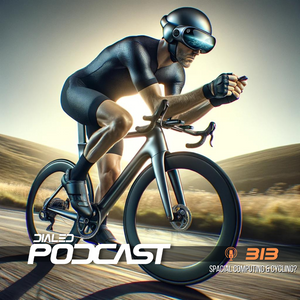
The Rundown: The guys dig into spatial computing and what headsets like the Apple Vision Pro could mean for cycling and triathlon. Matt shares his first-week impressions of the hardware, from the impressive visuals to the sweat, battery, weight and price problems, and the guys talk through why Zwift has never gone fully immersive on a trainer. They look ahead to lightweight glasses with a heads-up display for riders, wonder how AI will fit in, and cover a few other bits of racing news along the way. Read on for the highlights, then hit play above for the full conversation.
Dialed Podcast 313 recap
First impressions of the Vision Pro
Matt has had the headset for just under ten days and describes it as a wow experience with mixed feelings. The display is sharp and clear, and windows you place around a room stay exactly where you leave them, so a timer parked in the kitchen is still there when you walk back. In his view that sense of things feeling real is better than any VR headset he has tried.
The trouble is fitting it into daily life. Mornings and late nights are not great times to strap a screen to your face, and he admits he has not used it every day like he planned. When work gets hectic he takes the goggles off and goes back to real monitors.
Typing, working and staying connected
The guys talk through the different ways to type on the headset: a virtual keyboard you poke with a finger, looking at a key and pinching, or pairing a Bluetooth keyboard or laptop. Matt found the look and pinch method slower than he expected because of mistakes, and the physical keyboard the most efficient.
Jake raises the isolation problem. Two people can't wear headsets and see the same thing, so you end up in your own world, which is already an issue with phones. Matt's answer on whether you can really get work done in it is kind of, sort of, but not efficiently. Where he is excited is writing software for it, including a YouTube app of his own.
Riding with it: trainers, treadmills and sweat
For cycling, the headset does have a few clear upsides. On a trainer, especially in a time trial position, you can place a screen right where your head naturally sits instead of craning up at a monitor. Matt likes it for walking on a treadmill too, where you won't sweat much. A full sweat session is another story, and with so many expensive pieces he is careful with the whole setup.
The guys also talk about a review of someone riding outside with a headset on, and it only takes one mention of the screen going dark mid-ride to make the point that you are really looking at camera feeds, with limited detail at distance. Everyone agrees that is not a smart way to ride.
Why Zwift hasn't gone fully immersive
Matt describes trying Zwift in a VR headset years ago. It was gorgeous to look around the Zwift world, but turning your head while pedaling makes people lean and get dizzy, and staff had to stand on either side to keep riders from falling off the trainer. His guess is Zwift could flip the switch but hasn't because of the safety risk.
Jake wonders whether something like a trainer with a little built-in lean could help, but the guys settle on the missing piece being inertia and balance, which a trainer simply doesn't provide. A middle ground might be a big curved screen around you rather than full 3D immersion.
Glasses, heads-up displays and what's next
Both Jake and Matt see the Vision Pro as a stepping stone. Weight, a tethered battery pack and a lot of hardware make the headset awkward, and Matt thinks Apple is iterating toward glasses, possibly with a phone doing the heavy lifting. He guesses that is around ten years out, while Jake thinks things will move faster. Battery life of a few hours and a price of several thousand dollars are the reasons Matt tells people to try one in a store and then wait for later versions.
Lance, who is prone to motion sickness, is more drawn to a heads-up display in normal vision. Ideas include speed, heart rate and power in your glasses, a radar view of the car behind you, a voice-controlled coach and climb time estimates.
AI, fairness and the bigger picture
The guys agree that pairing spatial computing with AI is where things could get really interesting, though Matt thinks AI is the much bigger story. Jake shares some mixed feelings on AI in photography, where he likes editing in Lightroom but not generating things that were never in the photo.
Lance floats a fun idea of seeing stats on other riders in a race, and Jake asks the fair question of whether heads-up data would be an unfair advantage for those who can afford it, especially since some of it would not be legal under UCI rules. They wrap with a short Backpedal, Leadout News on early-season racing and One Last Thing.
Listen to the full podcast
This recap only scratches the surface. Hit play on the player above, or find Dialed Podcast 313 wherever you get your podcasts.
More Gear From This Podcast

Talk to the guys
Got a question or an idea for the show?
Ask us anything about the podcast, pitch a topic for a future episode, send general feedback, or ask about gear. We read every one.