

The short answer
If your rides move between sun and shade, start before sunrise, or finish near sunset, a photochromic lens is the one pair of cycling glasses we would tell you to buy. It is not magic, and it has real limits, so this post covers how it works, where it falls short, and what we carry.
We first wrote this post in November 2023 and rewrote it in October 2026. The lens details below were checked against the manufacturers' own pages in October 2026.
The moment you push your glasses down your nose
You are on a bright road in dark lenses when the route ducks into the trees, and suddenly the road surface is a gray smudge and you are peering over the top of your glasses at speed, trying to find the roots and the potholes.
Taking them off is not a great answer either. One of us got pinged in the eye on a ride once, and riding without glasses stopped being an option after that.
We have also lost count of the riders we have watched stop mid-trail to swap glasses. A photochromic lens is built for exactly that problem, because it gets darker in strong sun and clearer when the light drops, on its own, while you keep pedaling.
How the lens actually changes
The lens is loaded with dye molecules that change shape. Penn State's materials research center explains it like this: ultraviolet light breaks one bond in the molecule, the molecule rotates and settles into a flatter shape, and in that flatter shape it absorbs visible light. Nikon Lenswear says a photochromic lens holds trillions of these molecules, so the whole lens tints together.
When you take the UV away, the bond re-forms, the molecule folds back into its original shape, and the tint fades until the lens is clear again.
A photochromic lens darkens in response to UV light, not to how bright it is.That is why it barely tints inside a car, where the windshield blocks most of the UV.
What that explains on a real ride
- Cold mornings run darkerThe fade back to clear is driven by heat, so it slows down in the cold. A 2017 piece in the University of Waterloo's Chem 13 News explains that the lens sits darker at lower temperatures and takes longer to clear. On a frosty morning, expect more tint than the light seems to call for.
- The car is a dead zoneWindshield glass is laminated with a plastic layer that absorbs the UV these dyes need. Expect your lenses to stay clear, or close to it, on the drive to the ride, which is the chemistry working as designed.
- Shade takes a minuteDarkening is quick and clearing is slower. Tifosi puts its Fototec lenses at about 12 seconds to darken and about two minutes to return to their original shade. If you ride from open sun into heavy tree cover, the lens will catch up, just not instantly.
What the brands say, and what we carry
100% S2 Photochromic100% lists light transmission from 89 percent down to 24 percent, and says the tint shifts in under fifteen seconds.
Tifosi FototecTifosi says its Fototec lenses are polycarbonate, offer UVA and UVB protection, and use photochromic particles that darken on contact with UV.
Tint is not UV protectionThe American Academy of Ophthalmology says the darkness of a lens is not a measure of how much UV it blocks, so read the label.
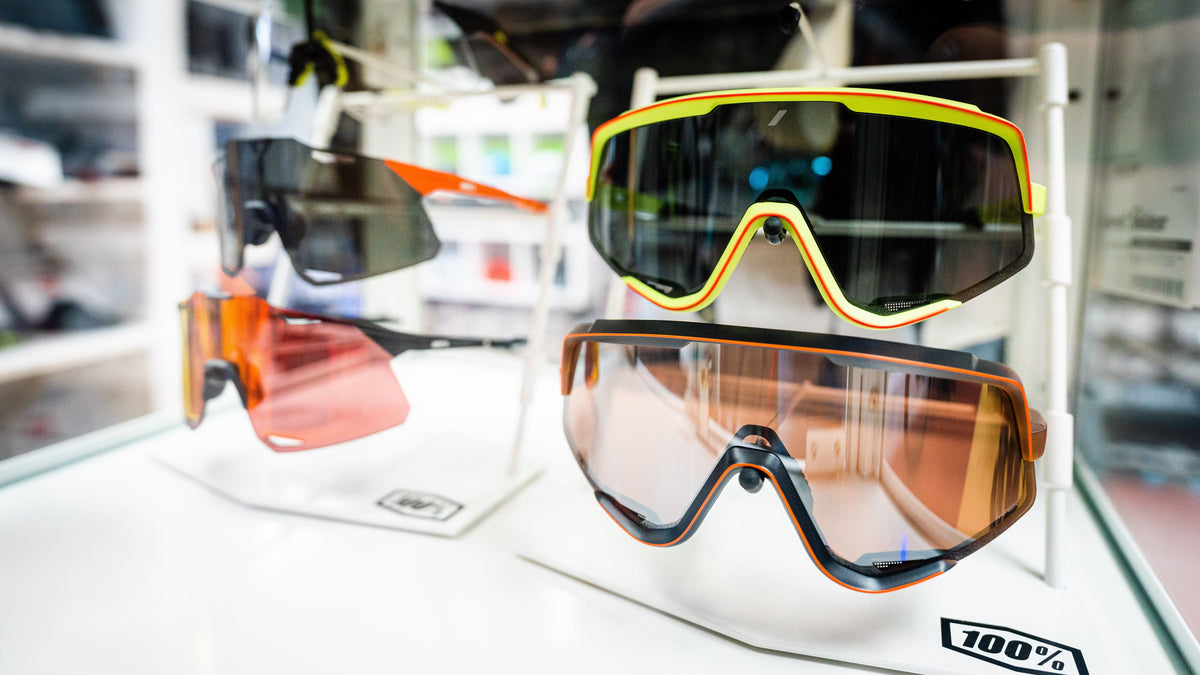
At the lab we carry the 100% S2 in Soft Tact Cool Grey with the photochromic lens, and the 100% Hypercraft in Gloss Black with a photochromic lens. On the Tifosi side, Fototec lenses come on the Moab Lite, the Rail, the Rivet, and the Sledge. There is also a Rivet Readers version in +1.5 for riders who wear readers.
Three years loose in a gear bag
When we first wrote this post in 2023, one of us had been wearing a pair of 100% S2 glasses with the photochromic lens for more than three years. They had been through rain, mud, snow, real heat, gravel, road, singletrack, a few small rocks, and a lot of time rattling around in a gear bag with no case, and they were still getting it done.
That is one pair and one rider, so take it as a story and not a lab test. It is also why this post exists: the old routine was wearing glasses too dark to see through in the shade, then pulling them off and riding with no protection at all, and the photochromic pair ended that.
It also simplifies the gear drawer, because one pair that handles most of the light you ride in beats two or three pairs you have to guess between before you leave.
Not every rider needs one. If you ride mostly midday, on open roads, in steady sun, a fixed dark lens does the job just fine.
Cold and snow can push it too dark. The same chemistry that keeps the lens darker on a cold morning is why the Chem 13 News piece says they can run too dark for things like skiing.
Near clear is not night vision. At its lightest the S2 lens lets through 89 percent of the light, but after dark your lights do the real work. We wrote about how to be seen and riding at night separately.
The whole pitch is one pair of glasses that works for the whole ride.
Want to try a pair on?

Every pair of sunglasses we carry is on one page, photochromic included, and we ship nationwide. If you are near the lab, bring your helmet and try them on with it. Questions? Ask us.
Shop sunglassesThen go ride the loop with the tree tunnel, because that is where you will notice the difference.