

We get asked this one a lot, and it is a good question. Almost nothing about this corner of the sport explains itself. Do I need road shoes and road pedals to ride a road bike?
Nope.
You probably do want to clip in. But the system most people get pointed toward is not the one most people should start on, and the reason has almost nothing to do with what the marketing tells you clipping in does.
Here is the honest version, in the order it actually matters.
The name is backwards, and that is not your fault
You buy a pedal you clip into, using a cleat, and the category is called clipless. That is not a typo. It is a leftover.
For most of cycling's history your foot was held by a metal cage on the front of the pedal with a leather strap around it. Those cages were toe clips. Then in 1984 Look introduced a road pedal with no cage and no strap at all. You stepped in, you twisted out. Clipless. Look followed it with the Keo cleat standard in 2004, and both are still the reference point for road pedals today.
So the name describes what got taken away, not what you are doing. Forty years on, we are all stuck with it. Clipless and clip-in mean the same thing, and neither one means flat pedals.
What does clipping in actually do?
Picture the last time this happened to you. Three quarters of the way up a climb, out of the saddle, and you put everything you have into one downstroke. Your shoe skates forward off the pedal. The bike lurches sideways. The pedal comes back around and finds your shin.
Anyone who has ridden flats knows that exact half second.
Here is the chain of events behind it. On a flat pedal, nothing holds your foot except friction and your own body weight pressing down. That is plenty at forty watts. It is not plenty at four hundred. When you stand up and load the pedal hard, the force stops pointing straight down and starts pointing forward and down, and the only thing resisting that forward push is grip. Wet shoe, worn pins, cold rubber, and the grip loses.
The same thing happens on every ride at a scale you never notice. Your foot creeps a few millimeters under load, resets when you unload, and creeps again. Thousands of times. Eventually you have a hot spot on the ball of your foot and a knee that is quietly annoyed with you, and you blame the saddle.
Almost everyone believes the payoff for clipping in is that you get to pull up on the backstroke. That is the one thing it does not do.The payoff is that your foot stops moving.
Do you gain power pulling up on the pedals?
We went and read the papers on this instead of repeating what everyone says, because it turns out everyone is wrong about it in a specific and interesting way.
Riders can be taught to pull up. Force-sensing pedals show it clearly. What happens next is the surprise: when you pull up, you get measurably slower for the same effort.
Three studies, one answer
Eight cyclists at 200 watts and 90 rpm, riding four different ways. Pulling up on the upstroke raised force effectiveness from 48 percent to 62 percent, and dropped gross efficiency from 20.2 percent to 19.0 percent. The technique that looked best on the pedal was the one that cost the most energy.
Eight elite cyclists and seven non-cyclists, given live feedback and told to pull up. Upstroke effectiveness in the elite group jumped 86 percent. Their net mechanical efficiency fell 9 percent.
The reason. Pedal force splits into a muscular part and a non-muscular part that is just gravity and the weight of your own leg swinging around. Gravity pushes the pedal down on the downstroke and fights you on the upstroke. Most of what a pedal reads on the way up is your leg, not your effort.
So the upstroke leg is not producing power. It is being lifted, mostly by the other leg. What a good rider does on the upstroke is get out of the way, which is unweighting, not pulling.
Now the part that cuts against us, because we would rather tell you the truth than sell you something. That same 2008 study also compared plain flat pedals to clipless pedals at steady endurance power and found no difference at all. Not in efficiency, not in pedaling mechanics, not in muscle activity. If your riding is flat, steady, and unhurried, clipping in will not make you faster, and anyone who tells you otherwise is guessing.
Where it does show up is the moment from the top of this section. Burns and Kram put twelve riders through maximal sprints up a 4.9 percent grade. Attaching the foot to the pedal at all was worth 9.7 percent more peak power. Adding a stiff cycling sole on top of that was worth another 16.6 percent. Steep, hard, out of the saddle. Exactly where your shoe used to skate.
That is the whole case, and it is a good one. Your foot lands in the same place every single revolution. The stiff sole spreads the load across your whole foot instead of stacking it on one spot. And when you stand up and put everything into it, nothing slips. Treat any promise beyond that with suspicion.
What are the downsides of clipless pedals?
You will fall over. Probably at a stop sign, at zero miles an hour, in front of people. It bruises exactly one thing and it is not your hip.
You have to walk in them. A three-bolt road cleat sticks out past the sole, so walking is a clacky, slippery business and tile floors become genuinely hazardous. A two-bolt cleat sits down in a rubber tread and you walk like a person.
It is a system, not a part. Pedals, shoes, and cleats all have to agree with each other. You cannot buy the pedal today and sort out the shoe later without checking the bolt pattern first.
All three are real. None of them is a reason not to do it.
Will any cleat fit any cycling shoe?
Here is the one that costs people money. Somebody buys pedals they liked the look of, buys shoes they liked the look of, gets home, and the cleat will not bolt to the sole.
Cycling shoes are drilled in one of two patterns and they are not interchangeable. Two-bolt soles take a small metal cleat that sits recessed in a rubber tread. Three-bolt soles take a big plastic cleat that stands proud of the sole. A shoe drilled for one will never take the other.
That is the part most guides tell you. Here is the part they skip.
Two-bolt is a shape, not a standard. Shimano SPD and Crankbrothers both use two bolt holes, and their cleats are not compatible with each other. Crankbrothers says so plainly: SPD cleats will not work in their pedals, and third-party cleats are not approved for their system. The holes in your shoe will line up perfectly. The pedal will refuse the cleat. Buy the cleat that matches the pedal brand, every time.
Speedplay goes its own way again and uses four bolts, but every Speedplay pedal ships with an adapter that mounts it to a standard three-bolt road shoe. Mounted straight to a four-bolt shoe instead, the stack height drops from about 11.5mm to about 8.5mm.
The three families
Road: three-bolt, one entry side, big platform
A wide cleat spreads your foot's load over a large pedal body, and the shoe under it is a stiff ventilated slipper with no tread worth the name. Excellent for long uninterrupted miles. Awkward everywhere else. You have to flip the pedal upright with your toe before you can clip in, which matters more in traffic than anywhere.
Shimano's SPD-SL family runs one cleat across the whole range, so you can move up later without rebuying shoes: the PD-RS500 and PD-R550, then 105 PD-R7000, Ultegra PD-R8000, and Dura-Ace PD-R9100.
Look still makes the system it invented: the Keo Classic 3, the Keo 2 Max and its carbon version, and the Keo Blade Carbon, which trades the spring for a carbon leaf blade.
Wahoo Speedplay is the oddball and the oddness is the point. The mechanism lives in the cleat instead of the pedal, which buys you a road pedal you can clip into from either side and float you can set anywhere from 0 to 15 degrees, independently in each direction. The Comp, Zero (also in a 56mm spindle for wider stances), and Nano all share one cleat, in standard and easy tension.
Shoes to go with them. Lake's CX line runs from the CX178 up through the CX239 and CX242, and Lake builds nearly all of it in a wide last as well as a regular, which is not a small thing if you have spent years quietly suffering in narrow shoes. The Giro Stylus is a sensible first road shoe, the Giro Regime steps up the stiffness, and the Sidi Shot 2 is for the rider who wants the full Italian race shoe.

Off-road: two-bolt, walkable, usually double-sided
Built for mountain biking, then adopted by gravel riders, commuters, tourers, and a lot of road riders who got tired of clacking across a coffee shop. The cleat is small and metal and recessed, so you can walk and hike and stand around normally. Most of these pedals engage from either side, which is worth a great deal when you are pulling away from a light with a car behind you.
Shimano's SPD system is the reference point: the PD-M540 is one of the best value pedals in cycling, and the Deore XT PD-M8100 is the race version.
Crankbrothers does it with an open four-sided wing on its own cleat standard. The Eggbeater 1, 2, and 3 are about as minimal as a pedal gets and shed mud beautifully. The Candy 1, Candy 2, and Candy 3 add a small cage around the same mechanism, and the Mallet 2 and Mallet Enduro wrap it in a full platform for gravity riding.
If you want a two-bolt pedal that behaves like a road pedal, Wolf Tooth machines the ALT XC and the single-sided DEL Gravel Race in Minnesota. Both take standard SPD cleats, and both let you rearrange the internal spacers to set your stance width at 51, 55, or 59mm at home. They ship at 55.
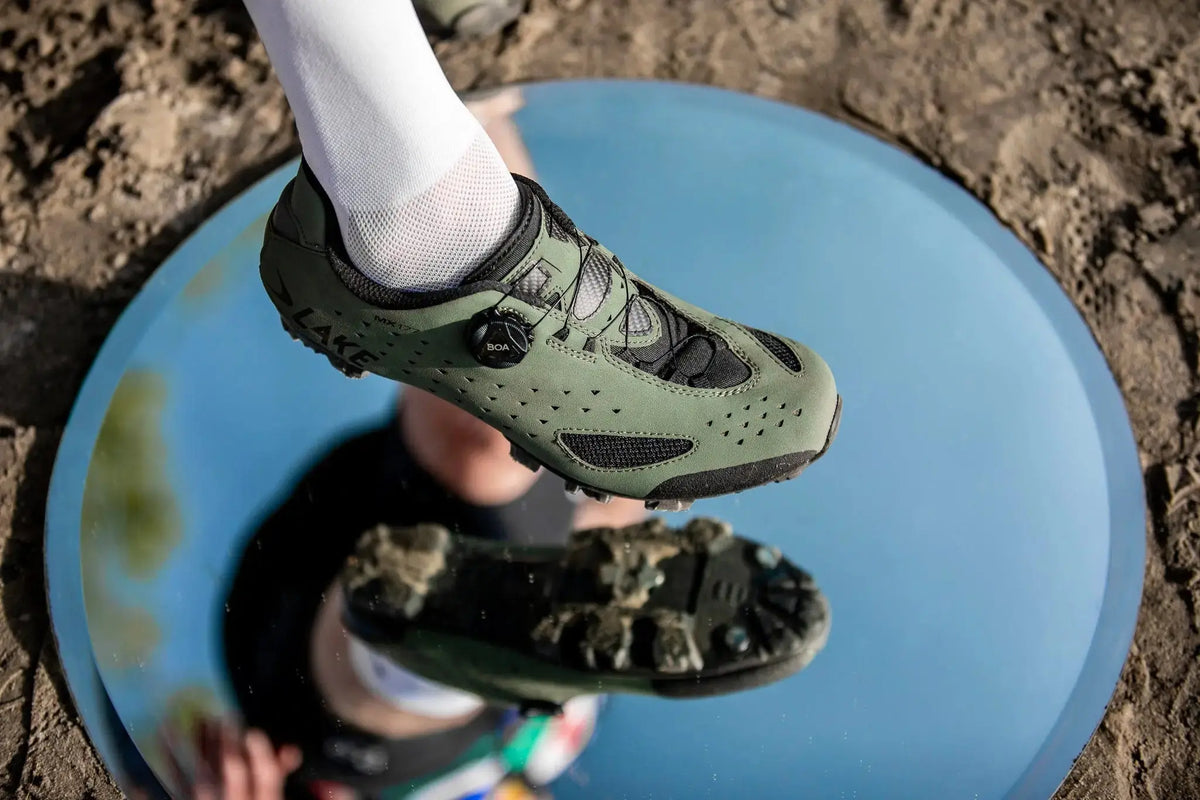
Shoes: Lake's MX line mirrors the road range, from the MX177 and MX190 through the gravel-focused MX239 and the MX242. The Scott Gravel Tuned and Sidi Gravel round it out.

Hybrid and flat: the version where you do not commit
Nobody talks about this option enough. There are pedals with a clip mechanism on one side and a flat platform on the other, so you ride clipped in on the open road and flip to the flat side in traffic or when you are running an errand in normal shoes. The Shimano PD-EH510, PD-EH500, and PD-T8000 all do this, as do the Crankbrothers Double Shot 1, 2, and 3.
And if you decide clipping in is not for you, that is a completely legitimate place to land. A good flat pedal with real grip, like the PNW Loam, the PNW Range Composite, or the Shimano PD-EF202, holds a foot better than most people expect. The research backs you up on the flat road, too.
So, do you need road shoes on a road bike?
No. Here is our take, and we will plant the flag on it.
If you are new to this, start on two-bolt SPD, even on a dedicated road bike. Not because it is easier. That argument gets made in both directions and we do not think it settles cleanly. Start there because it leaves you the most doors open.
One SPD setup covers road, gravel, and mountain equally. If you are not yet sure which of those you are going to fall in love with, that matters more than any spec on this page. If you already own bikes across two or three disciplines, it matters more still: one standard, one pair of shoes, every bike.
Then there is the walking, which is not a small side issue. A three-bolt road cleat on a dirt path or a gravel lot is miserable, and you will grind the cleat down and possibly chew up the pedal doing it. A two-bolt cleat sits recessed, so you can walk into a coffee shop without skating across the tile or wearing out the one part holding you to the bike. As long as the tread on your shoes has life left in it, you walk like a person.
The road setups that come back to us are almost never about the pedals. They are about tile floors, gravel parking lots, and the fifty feet between where you lock the bike and where the coffee is.
A fair number of people come in convinced they do not want to be attached to the bike at all. We put them on a pedal with a clip on one side and a flat platform on the other, and most of them stop flipping it over to the flat side within a month. Having the out is what makes them willing to try.
SPD is the only family where you can buy that pedal. Uncomfortable in traffic, tired at the end of a long day, riding something technical you have not seen before: flip it over and ride the flat side. And even on a plain double-sided SPD pedal, a two-bolt shoe resting on an unclipped pedal is far more rideable than a road shoe balanced on a road pedal. That is a real difference and almost nobody mentions it.
It is also the setup that lets the bike stay a normal bike. If you commute on it, or throw it on the back of the van for a camping trip, you can ride in whatever shoes you already have on. You do not need to pack cycling shoes to go get coffee.
And if this is a cost decision, SPD is the cheaper way in. Cleats run $21.99 a pair against $29.99 for Shimano's road cleats, and the pedals start lower too.

Road pedals earn their keep when the riding is long, fast, and uninterrupted. The bigger platform does spread pressure better over four hours, and a stiff road shoe is a nicer place to spend them. If that is most of your riding, go road. If it is about a quarter of it, do not let anyone talk you out of two-bolt.
There is one more thing we believe about road shoes, and we are going to be careful how we say it. As a general rule a road sole is stiffer and carries no tread, so less of your effort goes into the shoe bending under you. There is also a little less weight to haul up a climb than the same shoe built for dirt, which has a lugged outsole and a reinforced toe box on it. We think you feel both.
Two caveats, and they both matter. The first is that this is a tendency and not a law. Plenty of off-road shoes are built every bit as stiff as a road shoe, because cross-country and gravel racers want exactly that. Do not let the category answer the question for you. Look at the actual shoe.
The second is that nobody has measured the difference. The research that exists compared cycling shoes across a wide spread of sole stiffness and found no difference in power at all, and no one has tested road against off-road directly. So take our position as a position. Then rank it accordingly. Fit first. Then the shoe that suits the riding you actually do. Then stiffness, a long way back.
After enough years on both, we would rather be clipped in than on flats, on almost any ride.Not for the watts. For the control.
That belongs in a different box than the research further up, because it is a preference and not a finding. The studies that found no efficiency gain were measuring seated riders holding a steady wattage in a lab. A long day on the road is not that. It has climbs you stand up for, surges, rough pavement, and a final hour where you are tired and getting sloppy. Staying locked to the pedal through all of it feels like more control over the bike, and control is the thing you actually notice.
One more thing, if it applies. If a power meter is anywhere in your future, pedal-based power is the easiest way in and it will decide your system for you. The Garmin Rally comes in a Look Keo version, a Shimano SPD-SL version, and an SPD version, so two-bolt does not shut that door. The Wahoo Powrlink Zero builds it into the Speedplay platform.
Which cleats should you start with?
The cleat is where most of the character of a system lives, and it is the cheap part, so this is where a new rider can make life much easier for themselves. Float is the number that matters: how many degrees your heel can swing while you are still clipped in. More float is more forgiving on your knees, and it is where everyone should start.
Shimano road. Start with the yellow SM-SH11 at 6 degrees. Move to the blue SM-SH12 at 2 degrees only once you know your position is right.
Look Keo. The red Keo Grip gives you 9 degrees, which is a lot of room to find your natural angle. The gray is 4.5 and is where most riders settle.
Shimano SPD. The SM-SH51 is single-release: it lets go when you twist your heel out and not otherwise, which is what you want once the motion is automatic. The SM-SH56 is multi-release and exits in more directions, including upward. For a nervous first-timer the SH56 is a gift.
Crankbrothers. Both of their cleats are brass and both offer 6 degrees of float. The difference is the release angle, and that is the one you choose on. Their standard release cleat needs 15 degrees of heel twist to exit. Their easy release version needs 10, which Crankbrothers themselves recommend for anyone new to clipping in.
Whichever you choose, buy a spare set now and put it in a drawer. A worn cleat lets go when you did not ask it to, and that is a much worse afternoon than the parking lot tip-over.
Getting them on the bike
You need a pedal wrench or an 8mm hex, and one rule that saves somebody every year: the left pedal is reverse threaded. Both pedals tighten toward the front of the bike. Write it on your hand.
- Fore and aftBall of your foot over the pedal axle, or a few millimeters behind it. Behind is more forgiving.
- Side to sideSet your feet about as far apart as they sit when you stand up naturally.
- AnglePoint the cleat straight ahead to start and let the float find your real angle for you.
- TensionAll the way down. Every pedal has a small hex screw for this.
- Then waitRide a week before you change anything, and move in millimeters, not centimeters.
If your knees complain for more than a couple of rides, or one leg feels noticeably different from the other, stop guessing and go see a professional fitter. Cleat position and body geometry tangle together fast, and untangling them is a specialist's job.
How do you avoid falling on your first ride?
In a lot of years around this sport, we have met almost nobody who has not gone down at least once because they were clipped in. The bike stops, your brain files the unclip under later, and you go over sideways at walking pace like a felled tree. Everyone jokes that it is a rite of passage, and the joke holds up because it is basically true.
You can stack the deck, though.
- Set the release tension to its lowest setting before you go anywhere. You can always add more later. Nobody ever wished it had been tighter on ride one.
- Find grass, or lean on a wall, or put the bike on a trainer, and clip in and out thirty times on both feet until the heel twist stops needing thought. It is boring. Do it anyway. You are building the reflex that keeps you upright when a car pulls out.
- Pick your foot. Decide right now which one you unclip, and always unclip that one.
- Unclip absurdly early. A full block before the stop sign, until it goes automatic. You can coast a long way with one foot free and nobody will notice.
Common questions
Why are they called clipless if you clip in?
Because the name describes what got removed, not what you do. Before them, your foot was held by a metal cage on the front of the pedal called a toe clip. The pedal Look introduced in 1984 had no cage and no strap, so it was clipless. Forty years on the name is still backwards and nobody is going to fix it.
Do clipless pedals make you faster?
On a flat road at a steady effort, no. A 2008 study comparing flat pedals against clipless at submaximal power found no difference in efficiency, pedalling mechanics, or muscle activity. Where they do help is peak efforts. Attaching the foot to the pedal was worth 9.7 percent more power in maximal uphill sprints. Clipping in buys you control and consistency, not free watts.
Are SPD and SPD-SL cleats interchangeable?
No. SPD is the two-bolt system with a small metal cleat recessed into the tread. SPD-SL is the three-bolt road system with a large plastic cleat that stands proud of the sole. Different bolt patterns, different pedals, no crossover. An adapter plate can mount an SPD cleat onto a three-bolt shoe, but it adds height and usually removes your adjustment.
Can you use Shimano SPD cleats with Crankbrothers pedals?
No, and this one catches people. Both are two-bolt, so the holes in your shoe line up either way, but the engagement geometry is different. Crankbrothers states plainly that SPD cleats will not work in their pedals and that third-party cleats are not approved for their system. Match the cleat to the pedal brand, every time.
How much float should a beginner start with?
Start high. Six degrees on Shimano road with the yellow SM-SH11, nine on Look Keo with the red Keo Grip, six on Crankbrothers. More float lets your heel find the angle your leg actually wants instead of holding it somewhere it does not. You can always move to less once you know your position is right.
Am I going to fall over?
Probably once. It happens at a stop, at walking pace, and it is more embarrassing than dangerous. Set your release tension to its lowest setting before the first ride, then practice clipping in and out thirty times somewhere soft. That is most of the risk gone.
Can you walk in cycling shoes?
In two-bolt shoes, yes, more or less normally, because the cleat sits down in a rubber tread. In three-bolt road shoes, not really. The cleat stands proud of the sole, so you clack on hard floors, you slide on tile, and you wear the cleat down a little every time you do it.
If you would rather not do it alone
We mount pedals and set cleats to a starting point all the time. It is bench work and it is billed, so ask us for a number when you come in. What you get is a setup that is right on day one, and a place to practice clipping in and out that is not a busy intersection.
Pedals and cleatsAnd if you get out there, hate it, and come back for flat pedals, we will put those on too. Half of getting this right is admitting which rider you actually are.